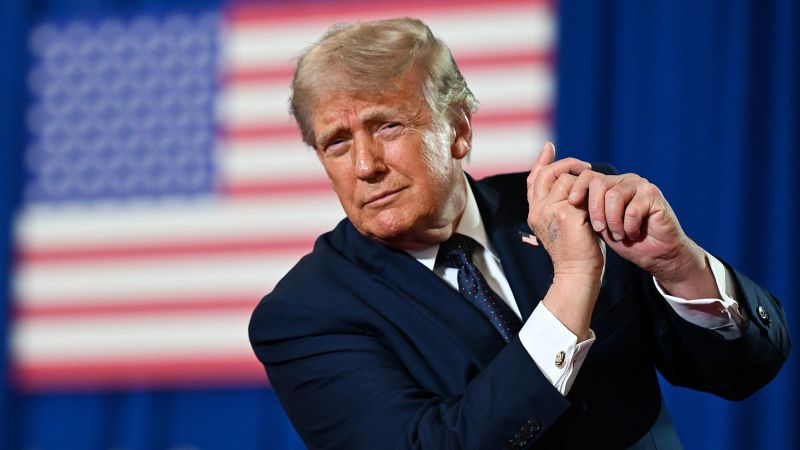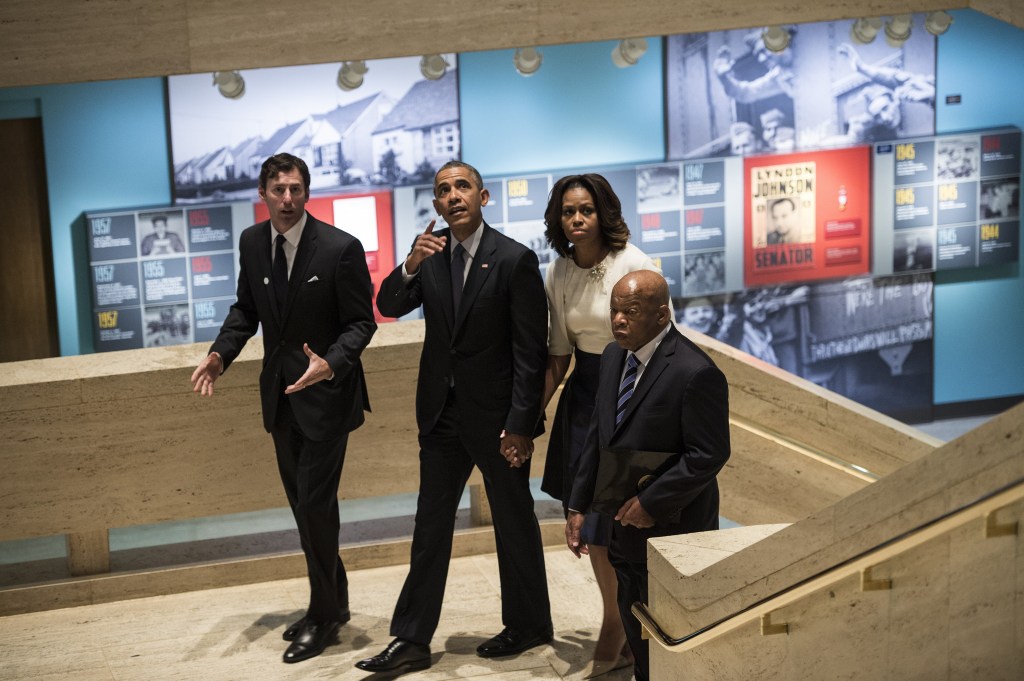
As the opening of the Barack Obama Presidential Center approaches and renderings of a future Donald Trump presidential library circulate, presidential libraries are back in the news — raising a broader question about what they reveal about our politics today. They also invite reflection on how we tell our political history.
I thought about those questions recently on a visit to three presidential libraries in Texas — those of Democrat Lyndon B. Johnson and Republicans George H.W. Bush and George W. Bush. I expected to find sharp differences between these presidencies. Yet what struck me most was not the contrast but the commonality.
To be sure, these were very different presidents. George H.W. Bush approached foreign policy as a cautious realist, while his son embraced a far more ambitious vision, seeking to use American power to reshape the international order after 9/11. Johnson’s expansive domestic agenda and escalation in Vietnam stood in sharp contrast to both.
But for all their differences, these presidents appeared to operate within a common political framework — one grounded in accountability to facts, responsibility for outcomes and acceptance of democratic processes.
Even in these carefully constructed spaces, each library confronts the most controversial aspects of its presidency. At the George W. Bush Presidential Library, for example, one display plainly acknowledges: “No stockpiles of (weapons of mass destruction in Iraq) were found.” It is brief and contextualized — but it is there. The Johnson library opens by confronting the Vietnam War as central to understanding his presidency, acknowledging how it ultimately consumed and compromised his time in office. And at the George H.W. Bush library, a closing video reflects on his loss to Bill Clinton, with Bush praising his opponent and affirming the legitimacy of his defeat.
I wonder whether such uncomfortable facts would be possible in future presidential libraries.
Individually, these moments are modest. Collectively, they point to something larger: a political culture shaped by expectations of accountability to facts, outcomes and democratic processes. However much they disagreed, these presidents operated within a shared understanding that power required justification, that failure could not simply be ignored and that electoral defeat was legitimate.
What is equally striking is the tone of presidential language. Presidential libraries are filled with recordings that let you hear these presidents in their own words. Even at their most forceful — LBJ’s “Johnson treatment” was real and unmistakable — their language did not carry the kind of open contempt or dehumanization that now shapes much of our political discourse. Across these recordings, there is a consistent emphasis on responsibility, character and a shared sense of humanity.
Much of this will not be surprising. We all understand that our politics have changed. Yet it is often difficult to fully grasp the extent of that shift in real time. Political norms rarely collapse all at once. They erode gradually, as each new violation becomes easier to accept than the last. What once would have been shocking begins to feel routine.
Part of Trump’s political success has depended on this process. Norm violations that might once have been disqualifying have become familiar. Resistance to acknowledging error, challenges to electoral outcomes and a more personalized, grievance-driven approach to politics no longer land with the same force — not because they are less significant but because they have become normalized.
That is what made visiting these libraries so striking. They offered a kind of compressed historical contrast — a reminder of a political culture in which acknowledging failure, accepting electoral outcomes and engaging with uncomfortable truths were not extraordinary acts, but expected ones. This is not simply a story about three presidents. It is a window into how expectations surrounding political leadership — especially around truth, accountability and service — have changed in ways we may be too close to fully see.
The point is not that the past was better or that these presidents were beyond reproach. It is that the standards by which we judge political leadership are shifting in ways that can be difficult to fully perceive in real time. Sometimes it takes stepping outside the present — walking through a different political world — to see how much our own has changed.
My trip to Texas offered just such a perspective. It also serves as a reminder of the importance of history — and of telling it honestly. Without that, we risk losing the ability to recognize change, both good and bad.
William Muck is a professor of political science at North Central College.
Submit a letter, of no more than 400 words, to the editor here or email letters@chicagotribune.com.