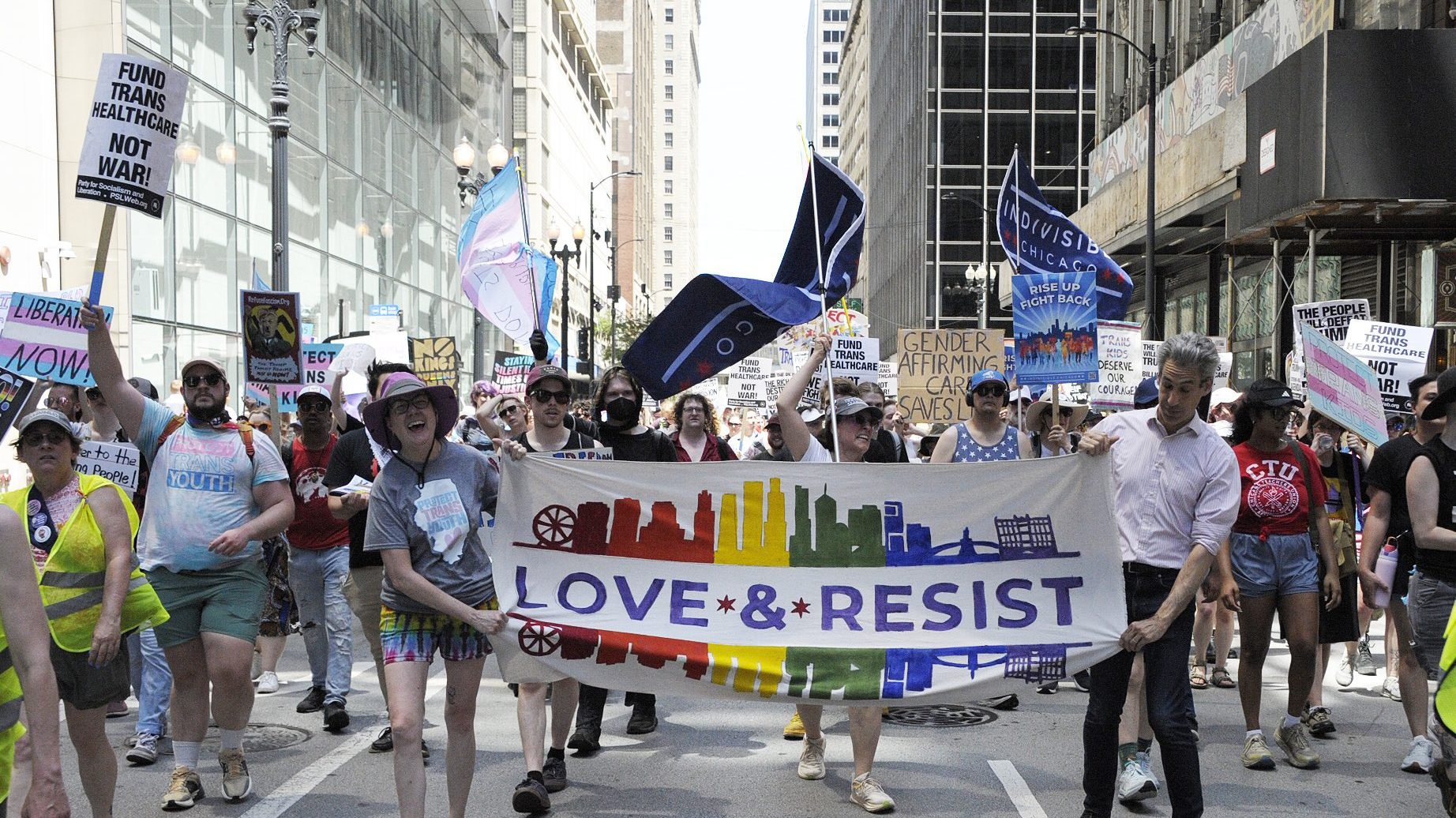
Pride Month in Illinois means multiple parades, parties and other celebrations of LGBTQ+ visibility and hard-won progress. But amid this year’s festivities is a growing sense of political urgency that harkens back to Pride’s protest roots.
This year’s Pride Month arrives at a moment of intensifying attacks on LGBTQ+ rights nationwide. And while Illinois has established itself as a safe state for queer people, advocates warn that federal political pressure is testing the limits of those protections and already reshaping daily life for LGBTQ+ Illinoisans.
“Sometimes the celebration of Pride can make it feel like we’ve made it,” said Channyn Lynne Parker, CEO of Equality Illinois, the state’s oldest and largest LGBTQ+ civil rights organization. “But we are in a political moment where the federal government is challenging many of those hard-won gains.”
Fighting back, Parker said, should be part of what Pride Month means in 2026.
“We cannot forego the celebratory aspects of Pride, because our joy is revolutionary—but Pride also needs to be a declaration that our fight is not over,” Parker said.

An LGBTQ+ refuge under pressure
For 18-year-old Ellison Gaines, this year’s Pride Month carries a different meaning. It will be his first since moving to Illinois from Texas, where escalating attacks on transgender people left him and his family searching for a safer place to live.

“It felt like a new world,” Gaines said of arriving in Illinois. “It felt like such a real opportunity to just exist more freely.”
Gaines is among a growing number of LGBTQ+ people and families relocating to Illinois in search of a safer climate. But he said the current wave of attacks on LGBTQ+ rights has also reminded him that even states with strong protections are not immune from political pressure.
Illinois’ reputation as a queer refuge has been decades in the making through efforts like the Illinois Human Rights Act, shield laws and other pro-LGBTQ+ legislation. But many of these protections are now under pressure from court challenges, investigations and funding threats.
“Our firewall of laws and protections has held, but nothing will stop a federal subpoena or demand,” said State Rep. Kelly Cassidy (14th District), one of two openly LGBTQ+ lawmakers in the Illinois General Assembly. “We can’t do anything about those pieces.”
Illinois schools have become one of the largest battlegrounds as the federal government challenges LGBTQ+-inclusive policies across the state.
In recent weeks, President Donald Trump’s Department of Justice launched investigations into 36 Illinois public school districts to determine whether they have included LGBTQ+-inclusive curriculum materials.

The investigations come amid broader federal scrutiny of LGBTQ+-inclusive school policies, including a congressional subpoena issued to Chicago Public Schools leadership.
Corey Lascano, LGBTQIA+ Committee Chair for the Chicago Teachers Union and director of education for Trans Up Front Illinois, said the investigations threaten the inclusive curriculum law Illinois passed in 2019 requiring public schools to teach LGBTQ+ history.
Lascano said teaching LGBTQ+ history in schools helps queer students feel affirmed while also encouraging broader understanding among all students.
“When schools start pulling back that kind of curriculum and support, students are left without those affirming messages—but the hostility and misinformation about LGBTQ+ people remains,” Lascano said.

Similar pressure campaigns have targeted major health care institutions, with the Trump administration threatening to withhold federal funding to providers offering gender-affirming care to trans youth.
A federal judge later blocked the policy after a multi-state lawsuit brought by attorneys general across the country, including Illinois Attorney General Kwame Raoul. But access to care remains limited in Illinois as providers have not resumed those services.
Ed Yohnka, director of public policy for the ACLU of Illinois, said this is part of a chilling effect in which institutions are preemptively complying with the federal government’s attacks in fear of retaliation.
“They’ve essentially been bullied to stop providing this lawful, necessary and life-saving health care to a group of people,” Yohnka said.
Also under threat is Illinois’ conversion therapy ban, which passed in 2015 and could face new legal challenges after theSupreme Court recently ruled against a similar ban in Colorado.

Cassidy, who spearheaded Illinois’s ban, said Illinois lawmakers are working on new protections that would allow conversion therapy survivors to sue practitioners even if Illinois’ ban is overturned.
“The things we thought were settled are very much unsettled right now, so we’re doing everything we can to prepare for that,” Cassidy said.
Gaines said the willingness of Illinois leaders to defend these LGBTQ+ rights is part of what makes the state feel different from Texas. Still, the current political climate has shown him that laws alone cannot guarantee safety.
“Even with all these protections, people are still going to do what they want to do,” Gaines said. “Sometimes those protections can feel more like suggestions than guarantees.”

Pride as resistance
The growing uncertainty around LGBTQ+ rights is also reshaping how many people in Illinois think about Pride Month itself.
For Gaines, Pride feels more politically charged this year. And seeing people across Illinois show up for one another during moments of political uncertainty has reinforced his belief that Pride is rooted in community and fighting back, he said.
“Pride feels different this year because people understand what’s at stake,” Gaines said.

Parker, who is entering her first Pride Month as CEO of Equality Illinois, has spent the last few months hearing from LGBTQ+ people across the state during a listening tour.
She said this year’s Pride arrives at a moment when many people feel both relief over Illinois’ protections and anxiety about growing federal attacks on LGBTQ+ rights.
“Thank God Illinois has chosen to protect LGBTQ+ people,” Parker said. “But Pride still needs to be a space for rest, joy, reflection on how hard we fought to get here, and recognition of how hard we still need to fight for what lies ahead.”