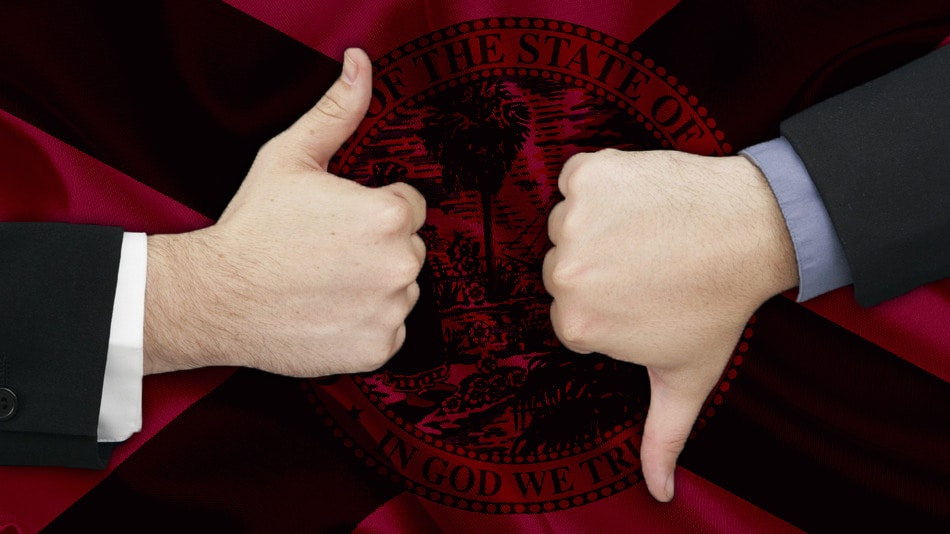
Gainesville has seen this movie before, and it didn’t end well the last time.
The University of Florida is again at the center of a brewing institutional crisis, this one centered in part on the school’s decision to name former University of Alabama President Stuart Bell as the sole finalist for the permanent presidency — the third presidential search the flagship university has conducted in four years.
The previous one ended when Santa Ono’s hiring collapsed in public, a spectacle that cost UF credibility and time. The question now is whether Bell survives the scrutiny that is already building around the process that produced him, the contract given to the man he is replacing, and the broader pattern of opacity that Florida’s most powerful Republican voices are no longer willing to ignore.
Credit U.S. Sen. Rick Scott for putting a spotlight on some of these questions. Scott fired off a letter this week to State University System Chancellor Raymond Rodrigues where. Scott blasted UF for naming Bell without any public input, and demanded an investigation into interim President Donald Landry’s contract — which includes a $2 million severance clause triggered if Landry is passed over for the permanent job.
Scott said the UF Board delegated authority over that multimillion-dollar contract exclusively to Board Chair Mori Hosseini, bypassing the full board entirely. “I don’t understand how that process is in the best interest of the university, its students and taxpayers,” Scott wrote. “It begs the question as to why UF even bothers to have a governing board.”

Alan Levine, who chairs the Board of Governors (BOG) overseeing Florida’s state university system, independently reached similar conclusions. Levine sent his own letter to Rodrigues asking the BOG to review whether university governance structures statewide comply with BOG regulations.
Levine, who has served on the Board of Governors for more than 12 years, said no formal governance review of this kind has occurred during his entire tenure. He called it “egregious” for a Board of Trustees to delegate a multimillion-dollar contract decision to a single individual, adding that such a move deprives the public of the ability to observe board deliberation on something material and potentially controversial.
UF pushed back, insisting on social media that it followed the exact process required under Florida law and operated with the transparency the law demands. That argument is technically defensible — the law does permit single-finalist searches, and a House bill to require broader public disclosure died in the Senate last Session with Gov. Ron DeSantis threatening to veto it anyway.
But following the letter of a law that multiple powerful Republicans now agree is inadequate is not the same as earning the public’s confidence, and at an institution conducting its third presidential search in four years, the margin for error is running very thin.
Now, it’s onto our weekly game of winners and losers.

Winners
Honorable mention: Keith Cate. Forty-four years is a long time to hit the right notes on air. Cate did exactly that, and Tampa Bay is a better-informed place for it.
Cate signed off from the WFLA anchor desk on May 20 with a résumé that most journalists spend a career trying to approximate.
He started in 1984 at a small station in Kingsport, Tennessee before working his way through markets in Baltimore, Atlanta and more. Tampa got him in January 2000, and Tampa kept him. For 26 years he anchored the 6 p.m. and 11 p.m. newscasts at WFLA, becoming a fixture in the media market.
You either have a relationship with viewers that generates longevity or you don’t. Cate had it.
His trophy case is remarkable: 14 Emmy Awards, four Edward R. Murrow Awards, a stack of Associated Press honors, and a Best News Anchor designation from the National Academy of Television Arts and Sciences.
What distinguished Cate wasn’t the awards, though. It was the range. He was in Moscow in 1991 as the Soviet Union collapsed. He stood on Omaha Beach in 1994 for the 50th anniversary of D-Day. He filed from Seville during the 1992 World’s Fair, traveled to Guantanamo Bay in 2006 to report on detainee treatment, and drove to a military hospital in Landstuhl, Germany, in 2005 to sit with troops wounded in Iraq and Afghanistan.
In 2009, he strapped into an F-16 with the Thunderbirds at MacDill and pulled nine G’s over Tampa Bay — which, for a local news anchor, is an assignment you remember. In 2016 he covered Barack Obama’s visit to Havana.
WFLA General Manager Mark Higgins called him one of the finest journalists he came across after more than 40 years in the business.
Cate is heading home — back to a family farm in Tennessee with his wife, Paula. He earned some time to relax and sit on the other side of the TV screen. Tampa Bay was lucky to have him for as long as it did.
Almost (but not quite) the biggest winner: The future of Tampa. Tampa residents looking to do big things under proven leaders got plenty of good news this week.
Both the Hillsborough County Commission and the Tampa City Council approved nonbinding agreements with the Tampa Bay Rays to continue negotiating a new stadium deal.
The target for a new stadium remains Opening Day 2029, and with both governing bodies now formally on record, the parties can move into working through the tougher specifics that will determine whether this memorandum of understanding turns into a full-fledged home for the Rays and a spark for a reimagining of the Hillsborough College Dale Mabry campus.
Commissioner Christine Miller, one of the five “yes” votes on the county side, put it simply: “Champa Bay was not built overnight.” She’s right. The Buccaneers and Lightning championships didn’t happen because Tampa settled for “almost.” Whether this project reaches that tier is still an open question. But two governing bodies voting yes in consecutive days after two decades of stadium failure gives those hoping to keep the Rays in town some hope.
And those wondering about the next chapter in city government, former Mayor Bob Buckhorn held his formal campaign kickoff Tuesday evening at the Rialto Theatre, and by every measure it landed well.
The event served as the public launch of a campaign that has been quietly accumulating advantages for months. His Friends of Bob Buckhorn political committee has $1.8 million banked. The next-closest declared candidate had raised just over $21,000 at the time of his filing. That gap doesn’t win elections on its own, but in a 10-candidate field, the ability to reach voters at scale while rivals are still introducing themselves is a significant advantage.
The kickoff also debuted a launch video built around testimonials from Tampa residents, business owners, and first responders.
Right now, he’s running like a front-runner because, by most available measures, he is one. And with the city embarking on a new era with the Rays, he could provide a steady hand the city needs.
The biggest winner: Service before self. There is no better day to raise up the importance of this ethos than Memorial Day, the most solemn U.S. holiday.
There are no campaign operatives to praise here, no poll numbers to cite, no legislative maneuvers to decode. This one is simpler than all of that, and more important than any of it.
Memorial Day exists because this country has never lacked for men and women willing to place themselves between harm and the people they loved — their families, their neighbors, their country — without any guarantee of coming home.
The concept of service before self is easy to praise and difficult to practice. Politicians claim it constantly. But the people this weekend is actually for didn’t just claim it — they demonstrated it at the cost of everything they had.
Florida has given more than its share. The state’s military footprint — from MacDill to Eglin to Mayport to the dozens of installations in between — means that virtually every community here has a family that knows what Memorial Day means in the most personal way possible, or knows someone who does.
The gold star on the window. The folded flag on the mantle. The chair that stays empty at Thanksgiving because someone decided the mission mattered more than his own survival, and was right to think so.
We spend a lot of time in this column on people who want power, who seek office, who maneuver for advantage in a system built on competition and self-interest. That’s the business. But once a year it is worth setting all of that down and acknowledging that the freedoms animating the entire enterprise — the campaigns, the elections, the arguments — were not free. Somebody paid for them.
Service before self is not an abstraction this weekend. It has a name — thousands of names, carved into walls and painted on headstones in Florida, the rest of the U.S., and overseas at the sites of the ultimate sacrifice.
Remember them.
Losers
Dishonorable mention: Florida Fish and Wildlife Conservation Commission. When conservative activist Charlie Kirk was assassinated, Brittney Brown — an FWC biologist specializing in bird conservation — reposted an Instagram story containing a joke about whales that jabbed at Kirk’s views.
“The whales are deeply saddened to learn of the shooting of Charlie Kirk, haha just kidding, they care exactly as much as Charlie Kirk cared about children being shot in their classrooms, which is to say, not at all,” the post said.
The FWC terminated her in September 2025. Brown filed a free speech lawsuit shortly after, arguing that a state agency had no constitutional authority to fire her for a private social media post on a matter of public concern.
Brown’s attorney Gary Edinger framed the case around a straightforward principle, that the government should not “decide which opinions its employees are allowed to hold.” Brown argued that FWC’s conduct reflected broader political pressure from Tallahassee filtering down into agency decision-making.
Those are, of course, the sort of big-picture arguments you have to make in this case. Supporters of Kirk and others who endorsed this sort of firing, meanwhile, could easily break this down as: There should be consequences when someone is this much of a jerk following the death of a public figure.
Look, the joke was offensive and really sort of lazy. To the extent you want to litigate Kirk’s record immediately following his death, much like controversies are revisited after any public figure’s passing, there are far better ways to do this, in our opinion, than a post like Brown amplified. We wouldn’t really argue that point.
But also, that is an opinion, and it’s the sort of thing that conservatives, often correctly, don’t want the government deciding.
And wherever you fall on that, there’s also this: The FWC explanation here was found to be false. U.S. District Judge Mark Walker sanctioned FWC Habitat and Species Conservation Director Melissa Tucker, who fired Brown, after Tucker testified that the agency received hundreds of complaints about Brown’s post. The actual number was 50.
If the case was so strong and the decision was justified, why exaggerate the impact?
The state of Florida seems to know the writing was on the wall, as they signed a $485,000 settlement agreement Thursday. The breakdown: $235,000 for the loss of her position, $40,000 in backpay, and $210,000 to cover attorneys fees and costs.
The FWC had no comment to outlets following the settlement. The $485,000 speaks for itself.
Almost (but not quite) the biggest loser: Carmen Mercedes Lineberger. No way to sugarcoat this one.
Lineberger, 62, a Port St. Lucie lawyer who spent nearly two decades as a federal prosecutor in South Florida’s Southern District, burned all credibility when a federal grand jury indicted her on four counts tied to the alleged theft of sealed government records from Special Counsel Jack Smith’s investigation into Donald Trump.
The indictment lays out a half-baked scheme that prosecutors say unfolded across two separate incidents. In the first, Lineberger allegedly pulled internal DOJ communications and a memo stamped for official government use only, renamed the file “Chocolate_cake_recipe.pdf,” and emailed the whole thing to her personal account. Then she allegedly saved the sealed volume of Smith’s final report on the Trump classified documents case to her government computer, renamed it “Bundt_Cake_Recipe.pdf,” and sent it from her DOJ email address to her personal Gmail.
Judge Aileen Cannon had ordered the report sealed at the request of Trump’s legal team. The indictment makes no attempt to explain why she wanted it on her personal Gmail or whether she planned to share it with anyone outside her own inbox.
Whatever this plan was supposed to accomplish, it did not pan out.
Lineberger has been admitted to the Florida bar since 1988. She joined the Southern District in 2008. She rose to Managing Assistant U.S. Attorney in Fort Pierce, then allegedly tried to smuggle classified documents out of the Justice Department disguised as pastry recipes, and here we are.
The charges against her are four in total: one felony count of obstruction of justice, one felony count of concealing government records, and two misdemeanor counts of theft of government property.
She appeared in West Palm Beach on Wednesday, entering a not guilty plea. The proof, in this case, is not in the pudding — according to prosecutors, it’s sitting in her sent folder.
The biggest loser: Debbie Wasserman Schultz. When DeSantis’ redistricting map dismantled her Weston-based seat in Florida’s 25th Congressional District, Wasserman Schultz faced a fork in the road that told you everything about what drives her.
One path led to the newly drawn Florida’s 22nd Congressional District — a nearly coast-to-coast battleground where Trump carried 55% of the vote in 2024 but where Biden narrowly won in 2020. In other words, it’s the exact sort of seat where Democrats need a high-profile, battle-tested candidate she claims to be in order to take advantage of a potential blue wave in November, but one where there is some risk of losing to a Republican.
The other path led to CD 20, a safe Broward seat where 68% of voters backed Kamala Harris in 2024, where the eventual Democratic nominee is essentially guaranteed a victory, and where a majority-minority population has historically elected Black Representatives.
She chose the safe seat. And after months of Democrats across the country bemoaning Republicans for carving up Black seats, Wasserman Schultz is now joining in the effort to undercut one of Florida’s best chances to elect a Black Representative.
The district already had several formidable Black candidates. Elijah Manley has been running there since last year. Former Broward County Mayor Dale Holness is in the race. So is Maisha Williams, daughter of the late U.S. Rep. Alcee Hastings. So is former 2 Live Crew frontman “Uncle Luke” Campbell and physician Rudolph Moise. And, remarkably, so is former U.S. Rep. Sheila Cherfilus-McCormick, who resigned the seat earlier this year ahead of an expected House Ethics Committee vote to expel her and who remains under federal criminal indictment for allegedly funneling millions in disaster relief money into her 2021 congressional campaign.
All are Black.
The backlash against Wasserman Schultz came fast and from people who are not her political enemies. State Sen. Shevrin Jones, a Miami Gardens Democrat who has called her a friend for years, said flatly that he will not support her run. “Black representation is a non-negotiable for me,” Jones said, adding that his fight is to expand Black political power, not diminish it.
The Florida Legislative Black Caucus issued a statement pointing out that Florida now has only two remaining Black access congressional districts, that CD 20 was built specifically to remedy racial exclusion, and that Wasserman Schultz moved forward without even granting a requested meeting with Caucus Chair Felicia Robinson to discuss the community’s concerns.
“The absence of that dialogue,” the caucus said, “demonstrates a lack of respect and engagement with the very constituents who are most affected by her candidacy.”
Manley, one of the candidates already in the race, said her move is “no different than the Republicans that are eviscerating Black representation across the South.”
Wasserman Schultz has co-chaired the Congressional Caucus on Black-Jewish Relations for years. None of that changes the basic political calculation she made: When forced to choose between a race she might lose in November and a race she can’t lose in November, she chose the one she can’t lose, and the community that built CD 20 is not having it.
She is, of course, taking the risk that she’ll lose outright in the Primary if CD 20 Democratic voters see this for what it is. But she’s also gambling that the Black candidates in the race will split the Black vote, allowing Wasserman Schultz to emerge on top, potentially with a slim plurality.
It’s the kind of ruthless power play you shouldn’t be surprised about if you have followed Wasserman Schultz’s career.
She has been in Congress since 2004. She chaired the Democratic National Committee through a tenure that ended in disgrace after leaked emails revealed her thumb on the scale against Bernie Sanders in 2016. She rebuilt, survived and accumulated seniority. She has also earned scrutiny over her stock trading as the conversation about lawmakers being able to play in the stock market has increasingly been under the microscope.
Seniority is genuinely the argument she is making to CD 20 voters — that her decades in Washington give the district more clout than a freshman member could provide. To be fair, it’s not an unreasonable argument. It’s also an argument she could have used in any other district.
She chose this one. Voters there now need to make their choice.
Source link ← Back to News