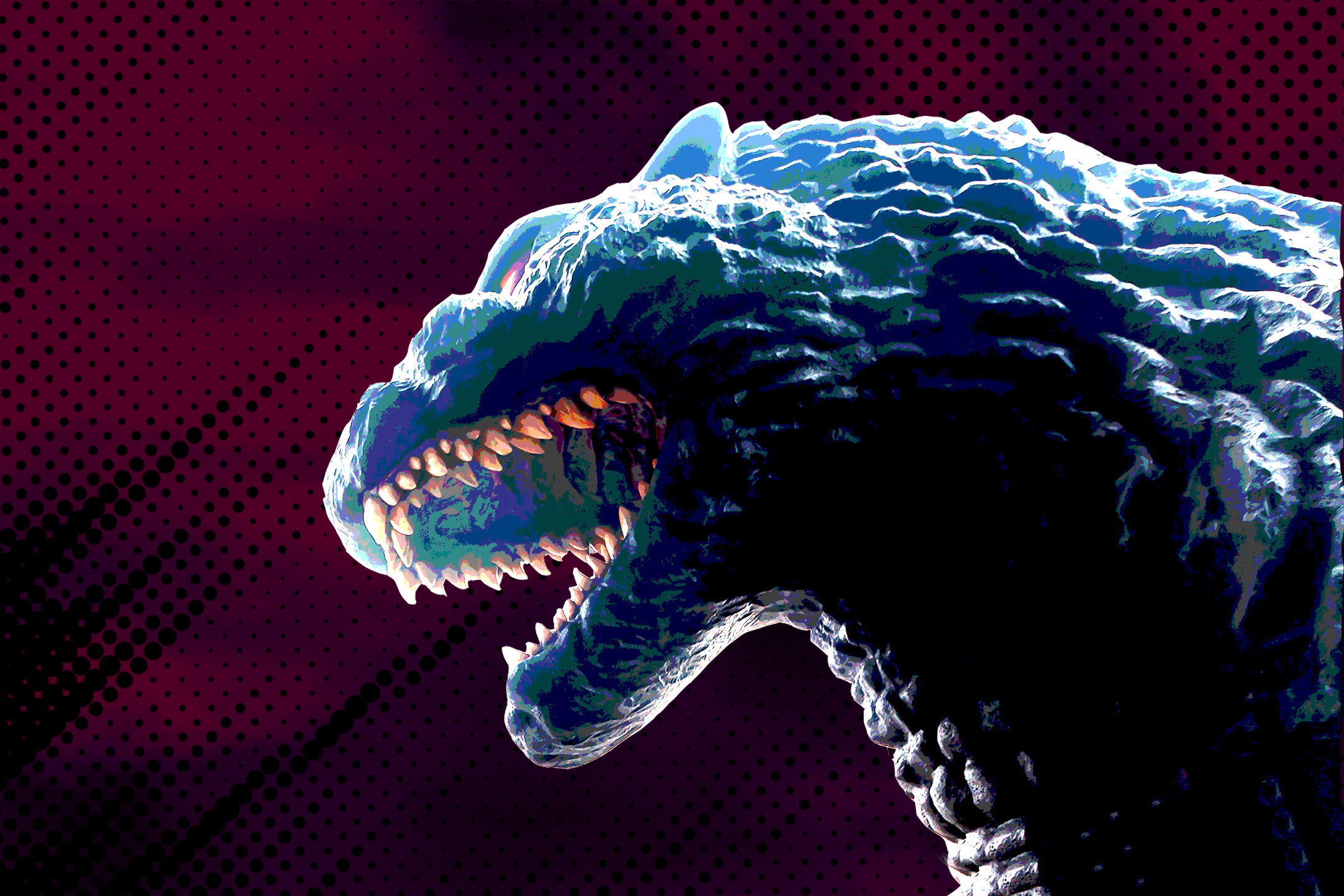
Slated for release this summer, The Horror of Godzilla is an upcoming comic from IDW that aims to retell the franchise’s original 1954 film with a bigger focus on horror.
Written by Ethan S. Parker and Griffin Sheridan, with art by Tristan Jones, the publication appears set to highlight what made the first film so unsettling, such as the slow build toward Godzilla’s reveal and the haunting state of his victims. It’s also expected to depict moments of human despair, such as the scene where a mother clutches her two small children and tells them, “We’ll be with your father soon,” as Godzilla advances toward them.
With Godzilla becoming more of an action franchise in recent years, it’s not a bad idea to remind audiences that, at their core, these stories are supposed to be part-horror. Here are five other times the Godzilla movies made that abundantly clear.
https://www.youtube.com/watch?v=AFiNvL9GPt0
Godzilla vs. Hedorah (1971)
Godzilla vs. Hedorah is probably best remembered today for its psychedelic imagery and the infamous scenes where Godzilla “flies” by propelling himself with his Atomic Breath. But what the movie should be remembered for is the first time that Godzilla ventured into body horror territory.
The film’s villain is the alien toxic-sludge monster Hedorah, who horrifically disfigures the king of the monsters during the final battle. Using its corrosive body composition and acid-muck projectiles, it melts Godzilla’s left eye, leaving behind a sickly yellow residue. The color ends up clashing with the grayish-white exposed bones of Godzilla’s right hand.
It’s important to remember that this happened before Godzilla developed the healing factor seen in later films, meaning that within the self-contained continuum of Godzilla vs. Hedorah, the king of the monsters effectively remains one-eyed and skeleton-handed forever.
https://www.youtube.com/watch?v=1tSl0A5oPz4
Godzilla vs. Biollante (1989)
Not all monster movies are automatically horror movies. It all ultimately depends on the humans in the story. In Frankenstein, the mere existence of an artificial human is unsettling, but what truly makes Mary Shelley’s story horror is the tragedy behind the Creature’s creation and humanity’s reaction to him. Godzilla vs. Biollante operates on a similar logic.
The titular Biollante is an artificial kaiju created by a scientist using Godzilla’s DNA, cells from a rose and what is essentially a human soul in a heartbreaking attempt to resurrect his dead daughter.
The desperation of a grieving father is palpable behind the rubber costumes and pyrotechnics, which only accentuates the terrifying end-result as the spirit of the young girl becomes trapped in a monstrous plant abomination. Her essence is only freed when Godzilla finally kills Biollante, turning the climactic monster battle into a tragedy about grief and the unnatural denial of death.
https://www.youtube.com/watch?v=juKkXEj6SZ0
Godzilla vs. Destoroyah (1995)
Godzilla vs. Destoroyah was at one point considered the final Godzilla movie, so it went all out with big set pieces, high stakes and a return to the franchise’s nuclear-horror roots.
In the movie, a colony of mutated prehistoric organisms awakens in modern times. Their attacks resemble those of a modern horror monster, dragging screaming people off-screen and leaving the grisly details to the audience’s imagination. As this happens, Godzilla overdoses on fissile material and begins to melt down, with the raging atomic energy tearing him from the inside in an impressive display of nuclear monster-body horror.
Ultimately, Godzilla dies as his flesh melts away from his body, transforming him from an iconic kaiju to a zombie, skeleton and finally a pile of ash.
https://www.youtube.com/watch?v=JFKVedgBpdo
Godzilla, Mothra and King Ghidorah: Giant Monsters All-Out Attack, abbreviated as GMK (2001)
One of the most fascinating parts of the Godzilla franchise is that the titular kaiju was almost never evil. The movies often went out of their way to portray Godzilla more as indifferent to the human world, making us feel tiny and insignificant in his presence while fearfully revering the world of nature. While those are the fundamental elements of Japanese horror stories, the movie that most fully embraced Godzilla’s horror roots is the one where Godzilla is angry, malicious and evil.
In GMK, Godzilla rampages through Japan because it’s possessed by the vengeful spirits of all those who died in World War II. Its terrifying white eyes, spine-chilling roar and malevolent nature make it drastically different from all previous versions of Godzilla.
When it attacks, its trail of destruction feels deliberate. When it destroys a hospital, the focus is no longer on the act of stomping a scale model but on all the lives lost in the process. And a giant, undead ancient beast that wants to hurt humanity is truly terrifying.
https://www.youtube.com/watch?v=_sm5nHpv6dI
Shin Godzilla (2016)
While a cutting satire of Japan’s glacial-speed bureaucracy, Shin Godzilla also didn’t skimp on the horror. Taking full advantage of the franchise’s first fully CGI Godzilla in a live-action film, Hideaki Anno and Shinji Higuchi reimagined the kaiju as the perfect organism that constantly evolves based on its needs, going from an aquatic form to an amphibian form to a terrestrial form, with all of them looking more than a little wrong.
The land version looks heavily inspired by the melted, zombie-like creature from the end of Godzilla vs. Destoroyah, but its preceding forms are also hard to look at. They feel incomplete, as if reality keeps fighting them because they don’t belong in the material world.
The final shot of the defeated Godzilla is the scariest because it shows frozen humanoid shapes emerging from its tail, a sign that Godzilla’s next evolutionary stage was a hive-minded, human-shaped entity after the kaiju deemed us to be Earth’s top predator. A little flattering, but also something to keep you up at night.
Related Posts
Updated On May 25, 2026
Source link ← Back to News