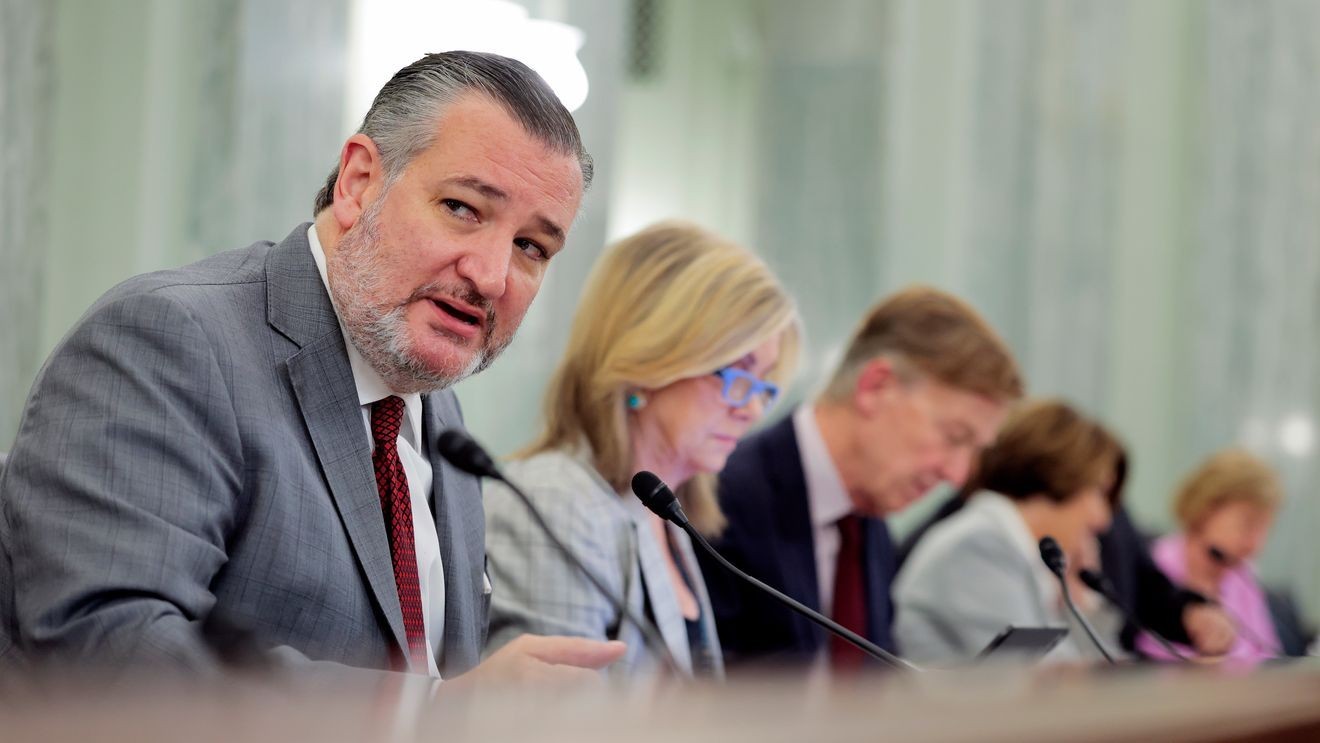
Congress' latest effort to "save" college sports was unveiled Wednesday when Senators Ted Cruz (R-Texas) and Maria Cantwell (D-Wash.) announced plans for a bipartisan college sports bill.
The "Protect College Sports Act" would limit transfers; put firm guardrails on player payment; enforce eligibility guidelines; prevent the creation of a Super League; provide the NCAA a limited antitrust exemption; and potentially pool media-rights money.
Senators Eric Schmitt (R-Mo.) and Chris Coons (D-Del.) signed on as co-sponsors with the bill potentially being introduced in the coming weeks. This development follows the SCORE Act, a separate bill aimed at fixing college sports. The bill, created by the House of Representatives, never reached a vote after the Congressional Black Caucus effectively shut down its momentum over concerns the NCAA would have too much power over student-athletes.
The main tenants of the 111-page "Protect College Sports Act" includes:
* Limit athletes to one free transfer during their college career
* Enforce a five-year eligibility window to play five seasons
* Disallow professional athletes from playing in college
* Allow up to $20.5 million in revenue sharing with athletes per year, per the House settlement
* Allow for stricter enforcement of NIL deals signed by athletes and enforce tampering rules
* Limit agents to a 5 percent fee on deals they brokered
* Disallow football coaches from leaving one school for another midseason
* Prohibit the SEC and Big Ten from creating a "Super League"
* And give the FBS the option of pooling their media rights
The most important aspects of the bill, if passed, would be transfer limits, a hard cap on NIL and revenue sharing, prohibition of a "Super League" forming outside of NCAA control and the pooling of media-rights money. The last item is likely the most controversial. It would require 75 percent approval from FBS schools, which means it could be approved without the support of the SEC and Big Ten, who have combined for an oversized influence on college sports.
The SEC distributed a record $1.03 billion to its members in 2024-25 with the Big Ten doling out $1.37 billion in distributions. In 2022, the Big Ten signed a seven-year media-rights deal worth $7 billion while the SEC is in the middle of a 10-year, $3 billion media-rights deal. Those conferences pay member schools more than $50 million per year, while the Mountain West, also in the FBS, is in the final year of a deal that pays schools $3.5 million per year, a figure expected to decline with its new media-right contract that was signed earlier this year following the loss of five schools to the Pac-12.
Some have argued pooling media rights could increase revenue, as evidenced by the NFL template, although the Big Ten and SEC are unlikely to agree to such a move given their current advantage in that space. While the remaining FBS schools could vote in favor of pooling media rights without their approval, Cruz has pushed the sides to come to a mutually beneficial agreement with Cantwell arguing the pooling of media rights could help conferences become more geographically aligned.
The Athletic obtained a letter signed by commissioners from 26 of the 32 Division I conferences sent to Cruz and Cantwell in which those commissioners expressed “enthusiastic support” for the bill. Neither SEC commissioner Greg Sankey and nor Big Ten commissioner Tony Petitti signed the letter.
The Protect College Sports Act could aid leagues like the MW, which includes schools like Nevada. Mid-major conferences have suffered major player losses via the transfer portal after being unable to match NIL and revenue-sharing payments offered by schools in Power 4 conferences. Meanwhile, the cost of doing business as a Division I athletic department has skyrocketed with universities picking up much of the tab on those increases.
Nevada athletics had a record $57,753,809 budget in fiscal year 2025 and has seen its university support increase from $6.132 million in fiscal year 2019 to $20.642 million in fiscal year 2025, a six-year increase of 237 percent. The Wolf Pack will request an additional $5 million in annual state support for fiscal year 2027 and 2028, with part of that money aimed at funding additional scholarships in women's sports.
University president Brian Sandoval, who is on the NCAA Division I Board of Directors, said in a conversation with NSN this week this kind of spending on college athletics in unsustainable and Congressional support to add guardrails is needed.
"I have publicly supported within the Mountain West and at the NCAA the SCORE Act, and I've had conversations with our federal delegation that this is the best path forward for the athletic department," Sandoval said. "I will say it's not sustainable because it just gets to be more and more and the bigger schools that have all the resources are better positioned to weather the storm. But even some of the schools within those conferences are running at major deficits. So, it obviously is much harder for us to be able to sustain this because we don't live in a big metro area with a ton of resources. And I'm really thankful for the resources that we've gotten from this community that allows us to get where we are.
"And, yes, the university has provided more institutional support to the athletic department. But that's out of necessity because of the change in the landscape and with the rev share that is happening. We want to be competitive. I think there is a recognition on campus that being successful in sports is really helpful to the university brand and marketing and attracting students to get here. It's just a combination of a lot of different things, but there is a line. At some point you can't continue to do it if it's going to hurt other parts of campus."
The Protect College Sports Act remains a long way from ratification and is expected to face significant hurdles to passage, with the Big Ten and SEC likely opponents and a deeply partisan and polarized Congress passing fewer bills in recent years.
Source link ← Back to News