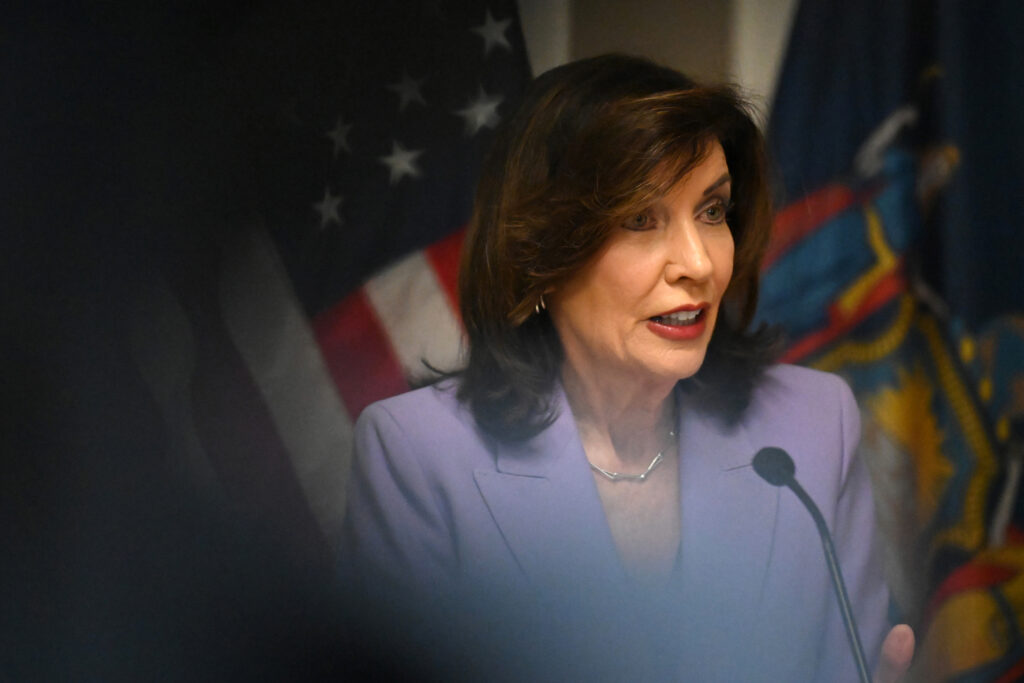
As part of ongoing budget negotiations, New York Gov. Kathy Hochul is pushing to delay emissions-reduction targets established in the state’s climate law.
Over the past year, Hochul has hinted that she doesn’t think the state can hit the targets established in the 2019 Climate Act: a 40 percent reduction in greenhouse gas emissions from 1990 levels by 2030, and an 85 percent reduction by 2050.
If Hochul gets her way, the timeline will change.
During a press conference this month, Hochul said the state will revise its emissions targets through the state budget process, aiming for a 60 percent reduction by 2040 while keeping the 2050 target intact. She said the economic policy needed to achieve those targets would not be announced until 2028.
“We cannot meet the current timelines without driving energy costs higher,” Hochul said at the press conference.
Across the state, environmental justice communities, and the legislators who represent them, argue the delays could expose more residents to prolonged, unhealthy living conditions, including living near gas-fired power plants or highways that produce significant traffic pollution.
“The Climate Act was at the core about reducing the disproportionate pollution burden on low-income communities of color,” said Eunice Ko, the deputy director of the New York City Environmental Justice Alliance.
An Emissions Problem
The governor has outsized influence over the state budget, making it easier for her to dictate policy changes. But working them into the budget means that they happen “without full transparency,” Ko said.
“What’s to stop her from doing that again to any other law that she doesn’t like?” Ko said.
Earlier this month, Hochul prematurely announced an agreement with the state legislature; negotiations are ongoing.
According to the state’s latest report, statewide emissions in 2023 were around 15 percent below 1990 levels—far from the 2030 goal.
In 2022, the state’s Climate Action Council, a group of scientists, utility representatives, policymakers and state agency leaders, released the Climate Scoping Plan. It set out a roadmap to meet the state’s climate targets.
The largest sources of greenhouse gas emissions in New York are buildings, electricity generation and transportation, according to state data. Under Hochul’s leadership, multiple policies designed to reduce emissions in those sectors have been delayed, and industry groups are pushing for more.
The state has delayed action on building electrification, which happens when a building transitions from gas heating and cooking to electric, to reduce emissions. The All-Electric Buildings Law, which was scheduled to take effect this year, would have imposed a gas ban on many new buildings. Buildings are responsible for almost 30 percent of the state’s emissions, according to state data from 2023.
Even electrification is no guarantee that the energy comes from renewable sources. In 2024, gas-fired power plants were responsible for nearly half of the state’s net electricity generation. The state has been slow to phase out these polluting plants, given rising electricity demand from data centers and electrification.
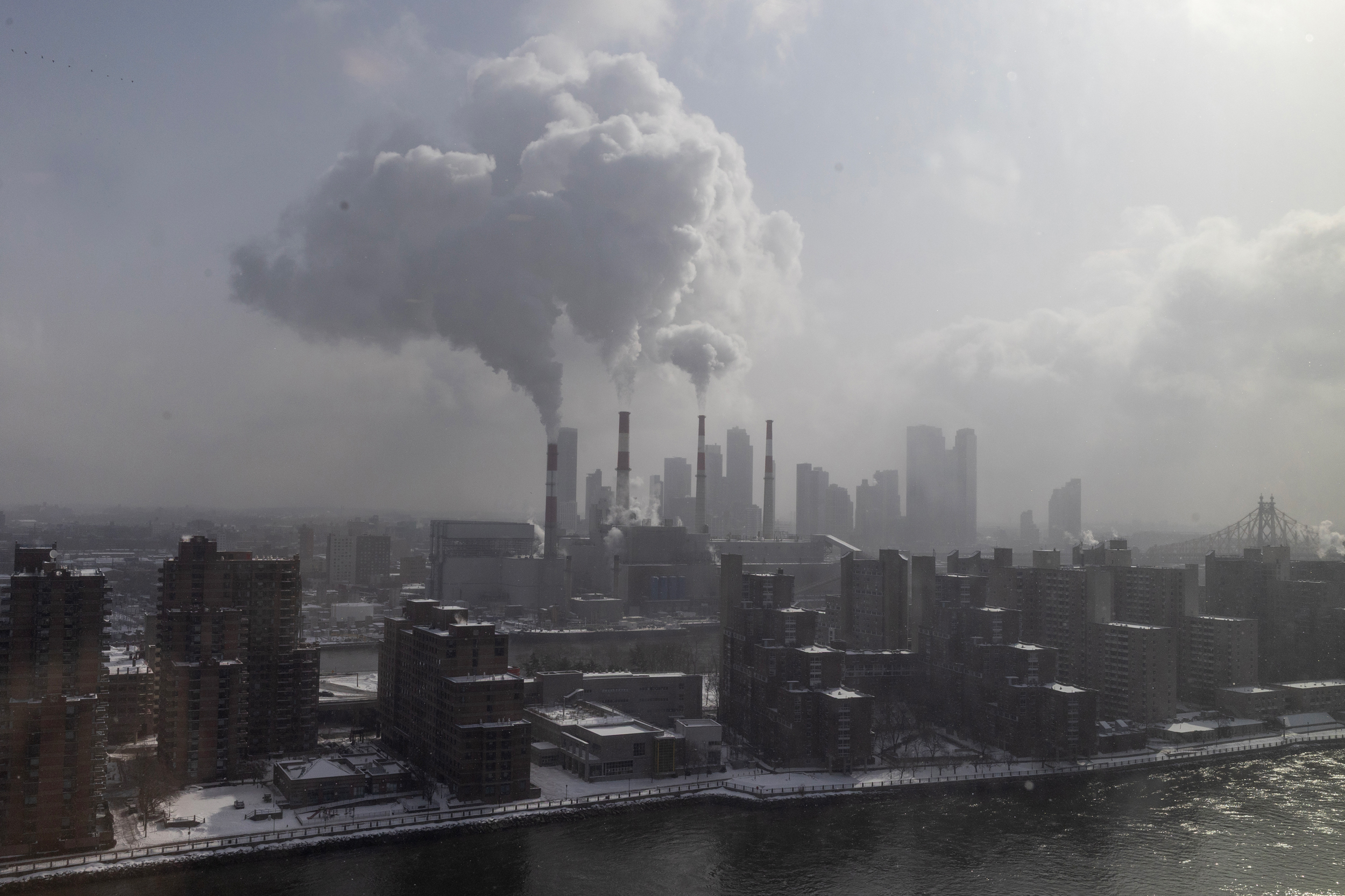
In April, the state agency that oversees the state’s electricity grid announced that two gas-fired power plants, called “peaker” plants because they operate during peak demand, will need to remain open until at least May 2029. They were slated to close last year partly because they worsened local air quality.
Though New York is struggling to kick its gas habit, the state outpaced its goals for small solar energy projects. Despite the Trump administration’s attempts to shut it down, an offshore wind project off the coast of Long Island is also due to start operations next year, which will power 500,000 homes.
In transportation, the state has also made some progress. From 2019 to 2025, the annual number of new electric vehicle registrations has increased eightfold, according to state data. But the number on the road is still a small fraction of the 3 million by 2030 called for in the climate scoping plan.
For larger vehicles, issues abound.
Many long-haul trucks are diesel-powered and release harmful pollutants—the climate scoping plan called for half of medium and heavy-duty vehicles to be zero-emission by 2030. The 2021 Advanced Clean Trucks Rule, which went into effect last year, requires truck manufacturers to sell an increasing number of zero-emission vehicles in New York. It has drawn opposition from trucking industry groups.
Financial Cost
A leaked memo from the state energy planning agency claimed meeting climate targets through the state’s original program—carbon pricing, also called cap-and-invest—would raise utility costs for residents and businesses. Under the program, polluters would buy and trade emissions “allowances,” allowing the state to collect money for renewable energy projects or utility bill rebates.
State Sen. Kristen Gonzalez, who represents portions of Brooklyn, Manhattan and Queens, questioned whether the memo was accurate, arguing that what drives up utility costs is the state’s reliance on imported oil and gas.
Gonzalez pointed to the high cost of replacing aging gas infrastructure, such as leaky underground gas pipes and gas-fired plants. The replacement of gas pipes has raised utility bills, as have increases in fuel costs.

The scoping plan, which sets out the path to meet the state’s climate targets, said “the cost of inaction exceeds the cost of action by more than $115 billion.” Dennis Elsenbeck, the former director of stakeholder and policy for National Grid’s U.S. operations who helped write the plan, said this “action” must include a change in how the state builds electricity infrastructure.
The state government, Elsenbeck said, needs to have long-term plans not only for the construction of clean energy projects but also for the transmission lines that will carry that electricity from where it is generated to where the demand is. He also said the regulatory process for new energy projects is too long; it can take well over five years in some cases.
Noah Kaufman, a senior research scholar at Columbia University’s Center on Global Energy Policy, said there is some truth to Hochul’s concerns about affordability. Most emission-reduction efforts will have a cost because they restrict consumer choices, he said, but it can be mitigated through utility bill rebate schemes for low- and middle-income customers and through long-term planning.
This story is funded by readers like you.
Our nonprofit newsroom provides award-winning climate coverage free of charge and advertising. We rely on donations from readers like you to keep going. Please donate now to support our work.
“Whenever you’re saying that … we’re not going to use all those available options,” he said, “it’s a bit like fighting with one hand tied behind your back. There’s a cost associated with that.”
A good way to keep costs down, he said, is to plan a decade or two in advance, because “that’s the period in which people consider changing vehicles or changing their furnace or boiler.”
“Continuing to Suffer”
Though the math surrounding greenhouse gas emissions seems abstract, its impacts are already being felt across the state, often by low-income communities of color.
Eric Walker, the energy justice senior policy manager for WE ACT, an organization that represents an environmental justice community in Harlem, worries about what this decision means for “putting people’s lives at risk and burdening people’s health, as well as their wallets.”
The Climate Act sets emissions-reduction targets, but it does not specify how to achieve them. It says the state should release regulations to meet its climate target by the end of 2024. The state published documents indicating its intent to implement a carbon pricing program, also known as cap-and-invest.
The state never released the full details to the public, prompting Walker’s organization to file a lawsuit alleging the state’s inaction violates the climate law. The judge sided with the environmental organizations and ordered Hochul to release the program regulations. Hochul partly blamed this decision for the changes she is making to the climate law.
“We need these dollars to invest in our communities, and the cap-and-invest program was supposed to bring billions of dollars every year,” said Ko of the New York City Environmental Justice Alliance. Ko said the organization had discussions with state agencies about implementing carbon pricing.
“Now communities are just continuing to suffer under the heel of fossil fuel industries,” she said, “and it means less money … for things that our communities deserve.”
A slowdown in climate action can have real-world health impacts on New York communities, especially amid a federal rollback of environmental regulations.
Gonzalez’s district is home to New York City’s largest fossil fuel power plant; residents refer to the neighborhood as “asthma alley.”
“My constituents are breathing poisoned air for a longer period than anyone should have to,” she said.
About This Story
Perhaps you noticed: This story, like all the news we publish, is free to read. That’s because Inside Climate News is a 501c3 nonprofit organization. We do not charge a subscription fee, lock our news behind a paywall, or clutter our website with ads. We make our news on climate and the environment freely available to you and anyone who wants it.
That’s not all. We also share our news for free with scores of other media organizations around the country. Many of them can’t afford to do environmental journalism of their own. We’ve built bureaus from coast to coast to report local stories, collaborate with local newsrooms and co-publish articles so that this vital work is shared as widely as possible.
Two of us launched ICN in 2007. Six years later we earned a Pulitzer Prize for National Reporting, and now we run the oldest and largest dedicated climate newsroom in the nation. We tell the story in all its complexity. We hold polluters accountable. We expose environmental injustice. We debunk misinformation. We scrutinize solutions and inspire action.
Donations from readers like you fund every aspect of what we do. If you don’t already, will you support our ongoing work, our reporting on the biggest crisis facing our planet, and help us reach even more readers in more places?
Please take a moment to make a tax-deductible donation. Every one of them makes a difference.
Thank you,

Reporter, New York City
Lauren Dalban is a New York City-based reporter with a background in local journalism. A former ICN fellow, she now covers environmental issues in all five boroughs. Originally from London, she earned a B.A. in History and English from the University of Virginia, and an M.S. from Columbia Graduate School of Journalism.