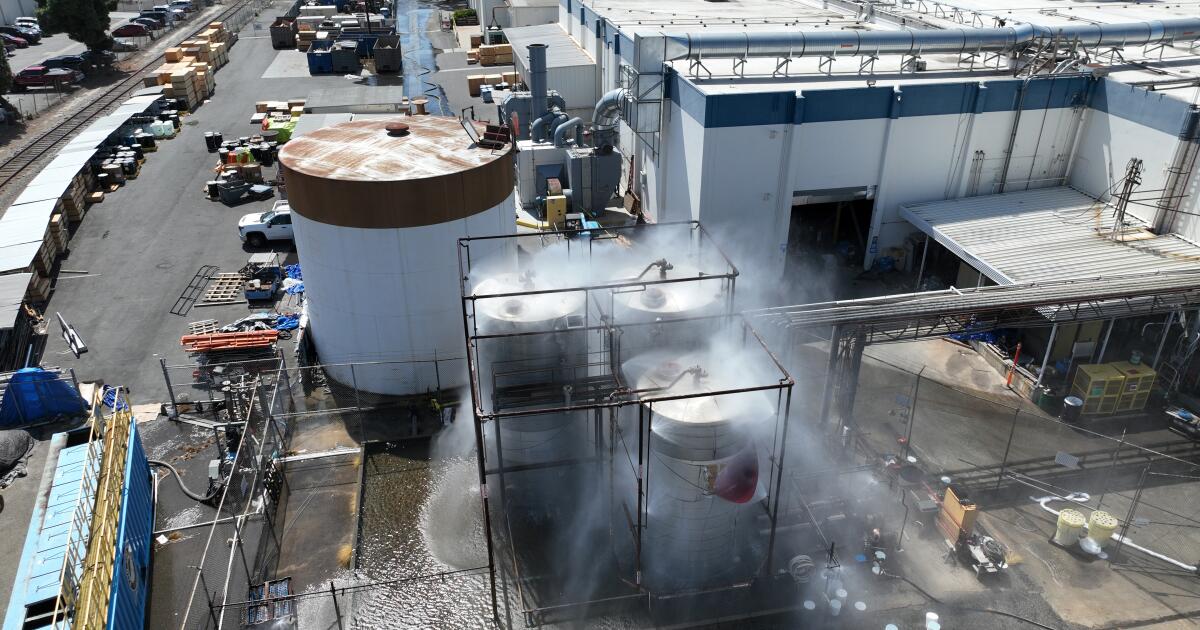
A large, pressurized tank filled with a toxic chemical in Orange County is at risk of either exploding or leaking, and officials say their options are highly limited.
By Friday night, fire crews were making progress lowering the temperature of the chemical tank, which is down to around 61 degrees, with 50 degrees being the goal, Craig Covey, an Orange County Fire Authority division chief, said.
That could enable crews to implement some solutions that don’t involve an explosion or destructive leak. But there is still a ways to go before the area is safe for people to return.
Why is the chemical in this tank so dangerous right now?
Inside the tank is an estimated 7,000 gallons of a chemical used to make plastics called methyl methacrylate, or MMA, stored in liquid form.
“It’s durable, lightweight, transparent, so it could even be used as a substitute for glass,” Elias Picazo, assistant professor of chemistry at USC, said of the final plastic product. The polymer can also be used in household goods as well.

The polymer itself isn’t toxic, but its liquid MMA predecessor — a monomer, essentially a bunch of single molecules — is. If it gets into the air, it can harm people at high concentrations and through chronic or extended exposure.
“The other hazard is the explosion itself. And it sounds like it’s already the reaction has already initiated, and that’s where the worry comes in for the explosion,” Picazo said.
In chemistry, there’s a concept known as “thermal runaway reactions. And those are really hard to control,” Picazo said.
If the temperature of the tank exceeds a certain threshold, Covey said, “we know the tank is going into thermal runaway, and we’re going to pull everybody out of the area, make sure it’s safe, and let the tank do what it’s going to do.”
How did the crisis begin?
The crisis began in Garden Grove on Thursday, when a tank with MMA started to experience an increase in temperature. At one point, the tank began bulging, and “it got to a point where it does what we call a BLEVE, which is a ‘boiling liquid expanding vapor explosion,’” Covey said Friday afternoon.
It’s not clear what problem caused the increase in temperature in the chemical tank.
But it’s something that should not have happened, experts say.

What happens when you combine heat with this chemical in a large, pressurized tank?
Some chemical reactions can be initiated with heat. With MMA, heat can cause a reaction, but then it causes more heat.
“You can start to see the problem. You have a reaction that is initiated by heat, but it also releases heat as it goes on, that then leads to the runaway, where it’s uncontrollable,” Picazo said. “And this is a very large scale reaction that produces a lot of heat very quickly.”
And this is all happening in a tank with high pressure.
“If you build too much heat or pressure, then you get the explosion. And the material is also highly flammable, in addition to being toxic, and so you can have, fumes of toxins, flames like literal fireballs, and the explosion itself,” Picazo said.
The worst-case scenario is an uncontrolled explosion. “If you’ve ever seen videos of tank cars on a railroad track blowing up, and that fireball it puts out, and it blows half the tank car a half a mile down the train track, that’s the incident potential we are dealing with if this suffers a catastrophic failure,” Covey said.
Another scenario that could involve significant environmental damage to waterways and the ocean is a massive leak, although such a leak would make the chemicals no longer at risk of exploding.
From there, teams in hazardous material suits can go in and “neutralize and mitigate the vapors that will be coming off of that,” Covey said.
Can anything be done beyond waiting for an explosion or a massive leak that threatens streams, rivers and the ocean?
The main strategy right now is doing everything possible to keep the tank cool.
Crews on Thursday were able to cool the tank down with sprinklers leading officials to think the problem was being resolved. But conditions worsened Friday when they discovered they could not offload a neutralizing agent in the failing tank because the valves had broken and were gummed up.
This would’ve been a good solution had they been able to get the neutralizing agent in the tank. MMA is an electrophile — it likes taking electrons, and “if you add another molecule that is a nucleophile that likes to give electrons, you can quench it, you can kill the reaction, you can stop the reactivity of whatever remains,” Picazo said.
Firefighters on Friday reissued evacuation orders and expanded the zone to include portions of the cities of Garden Grove, Anaheim, Buena Park, Cypress, Stanton and Westminster. They warned that they were told that at that point, the only two options ahead of them was either a massive leak or an explosion.
But they are buying time now using cool sprinklers to try to keep the tank’s temperature down.
That’s a viable solution, Picazo said, to “just wait it out by keeping the tanks cool. So by controlling the runaway, you can slow down the reaction and you can do your best to maintain the pressure.”
Covey said in an update on Friday night that efforts to cool the tank by spraying it with water have been successful so far.
“Those efforts are succeeding and it’s giving us opportunity to reconsider engaging in close proximity to implement some of the concepts…to mitigate this thing,” he said.
Key questions for officials, Picazo said, will be determining how much MMA remains in the tank “and how to quench whatever is remaining.”
One tank on Thursday did release vapor after the tank experienced an increase in temperature. By Friday afternoon, firefighters had cooled the tank enough that a valve on top of the tank was no longer purging any kind of chemical.
If the temperature is equilibrating and the tank is no longer venting substances in the air, one possibility is that the reaction could be done. “I wonder what would happen if they stopped trying to cool the tank, if it would start heating itself again,” Picazo said. “Basically, I’m wondering if the reaction is over, or, or if upon stopping the cooling mechanism, if it would re-initiate itself.”
What could’ve caused the valve in the tank to clog up, making it impossible to put a neutralizer in the tank that would resolve this crisis?
One possibility is that the MMA chemical has already reacted in the valve and gone from a liquid to a solid state.
“Maybe the material has already polymerized in that outlet,” Picazo said. “And so you can’t get anything in or out from it, because the monomer — which is a liquid — once it polymerizes, it becomes that plastic, glass-like material, and that’s solid, so nothing’s going to go in or out.”
Has anything like this happened before?
Officials called this particular situation unprecedented Friday. But in a region dotted with chemical facilities, refineries and other heavy industries, accidents do happen.
One recent incident occurred in October at the Chevron oil refinery in El Segundo, triggered after a large fire broke out in a corner of the refinery where crude oil is turned to jet fuel, and resulted in a violent blast that rattled homes up to one mile away. Details on the cause and the extent of the environmental fallout haven’t been released.
In 2015, an Exxon Mobil refinery in Torrance suffered an explosion; no one was seriously hurt. The U.S. Chemical Safety Board said Exxon Mobil relied on outdated procedures and used equipment that was older than its safe operating life, adding that the explosion had the potential to be catastrophic because of the presence of a highly toxic chemical, hydrofluoric acid, on site, which can immediately penetrate the skin and destroy tissue.
One of the deadliest industrial accidents in U.S. history involved the ignition of highly flammable fertilizer aboard a cargo ship, the SS Grandcamp, in Texas in 1947, according to the Bullock Texas State History Museum. The ignition was caused by a fire aboard the ship, igniting 2,300 tons of ammonium nitrate, killing an estimated 581 people and injuring thousands. The first explosion ignited a second explosion at a nearby Monsanto Chemical Co. plant and caused a fire on another ship, the SS Highflyer, which then exploded 16 hours later.
That disaster “brought about new regulations for the chemical manufacturing industry,” the museum said, including requiring cool temperatures and special containers for shipping ammonium nitrate and banning storage near other reactive materials.
Times staff writer Tony Briscoe contributed to this report.