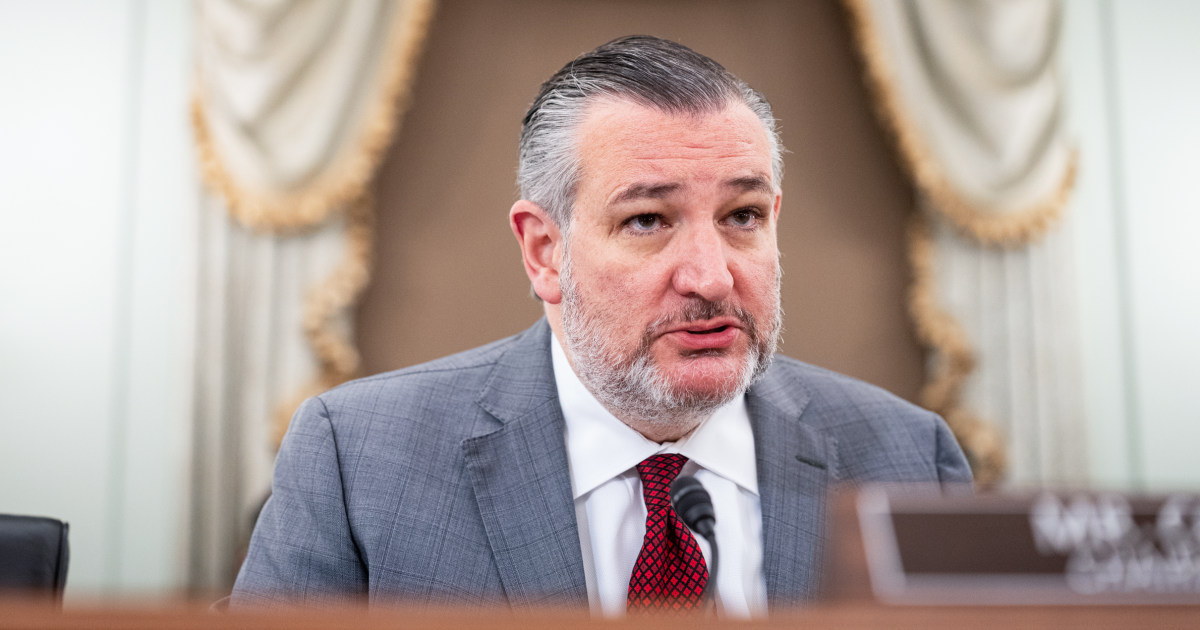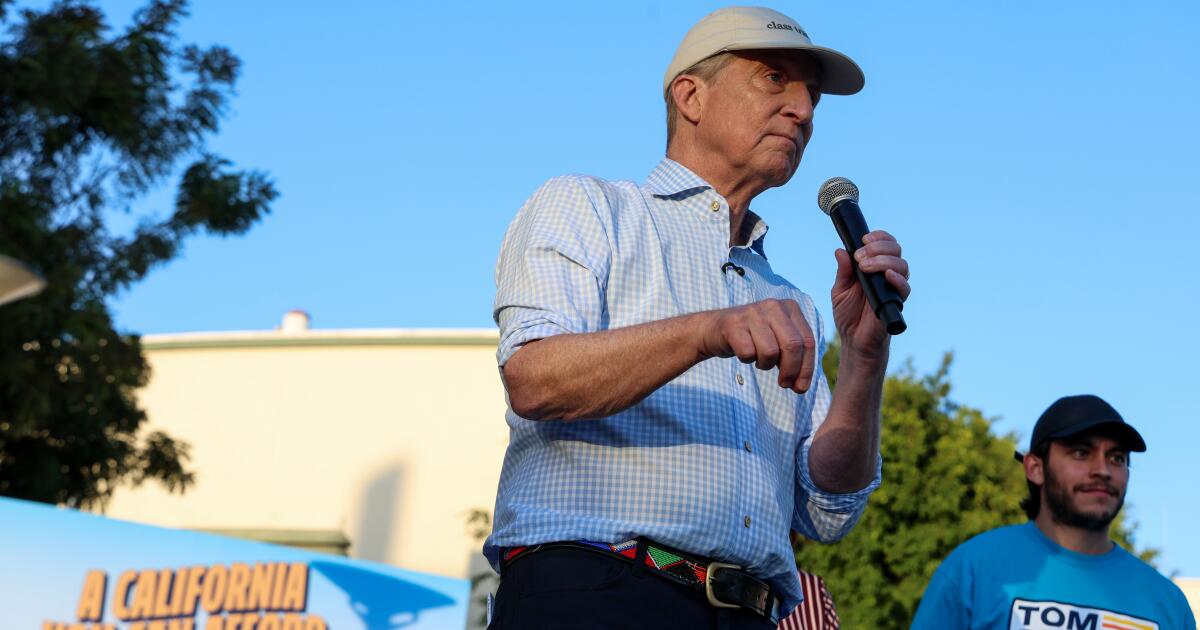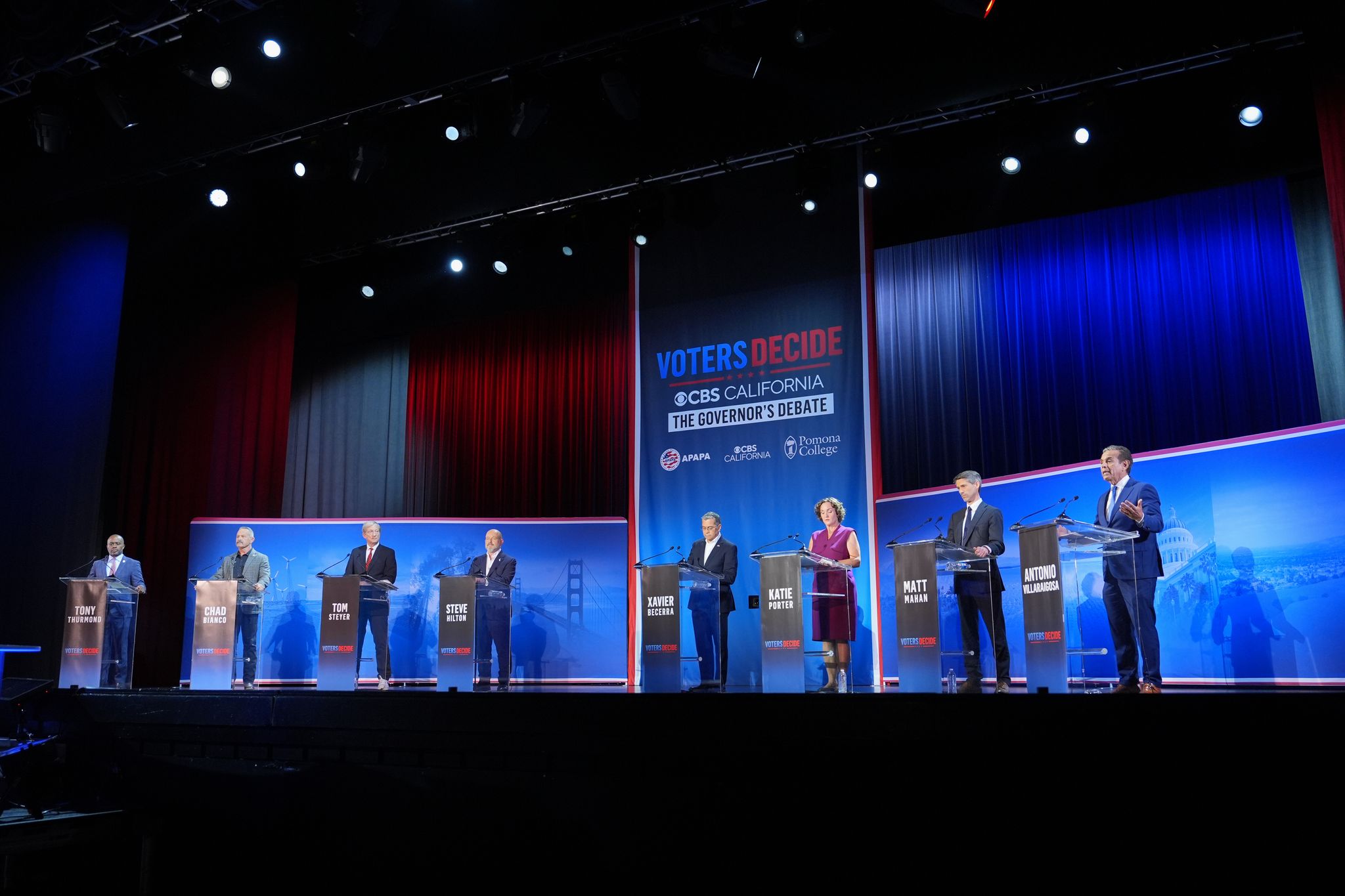

From left, California governor candidates Tony Thurmond, Chad Bianco, Tom Steyer, Steve Hilton, Xavier Becerra, Katie Porter, Matt Mahan and Antonio Villaraigosa debate in Claremont (Los Angeles County) in April.
Across California, blank ballots are sitting on kitchen tables, staring back at Democratic voters undecided about whom to back for governor. Many voters remain stumped, days before the June 2 primary.
The dilemma for Democrats debating between their party’s two top-polling candidates, former Health and Human Services Secretary Xavier Becerra, who has spent much of career holding elected office, or former San Francisco hedge fund manager Tom Steyer, a billionaire who has never held elected office: “Do I vote for the career politician with the record that’s being criticized or the billionaire who made his fortune in part by investing in nefarious things and has no experience in public office whatsoever?”
Article continues below this ad
Meanwhile, others not enamored by either candidate might fear throwing away their vote by backing one of the lower-polling Democrats. If I vote with my heart for a lower-polling candidate, the thinking goes, will that risk sending one or two Republicans to the general election?
The lack of a consensus around a candidate in this crazier-than-usual campaign reflects why many Democrats are still searching. Some are hesitant to commit after seeing former Rep. Eric Swalwell implode after the Chronicle’s bombshell investigation revealed allegations that he sexually assaulted a female staffer. That hesitancy — and the lack of compelling candidates — may explain why 13% of Democrats remain undecided.
The two Democrats closest to advancing to the general election, according to most polls, are Steyer and Becerra.
Experience-wise, they couldn’t be more different. Voters seeking an experienced hand might gravitate toward Becerra’s many years in public office, in a variety of state and federal roles. Those seeking a nonpolitician’s perspective on California’s problems might be impressed with Steyer’s business and advocacy background. Both come with pitfalls: Becerra’s long résumé means there is plenty to criticize when it comes to the choices he’s made as a public official. Steyer’s non-résumé in public office means it’s hard to predict how he might approach problems that arise in government leadership roles.
Article continues below this ad
Progressive groups and icons including Sen. Bernie Sanders, independent-Vt., and former Labor Secretary Robert Reich have endorsed Steyer, who pledges to be the “billionaire who can take on the billionaires.” Meanwhile, Becerra, the former state legislator, House member and state attorney general, is corralling institutional support while cultivating an image as “Tio Xavier,” as the audience chanted at a recent labor rally in San Francisco, the even-keeled uncle who knows how to get stuff done by working inside the system.
It is an underwhelming choice for many Democrats in the nation’s bluest state. For those pondering whether to support Becerra, Steyer or someone else, here are some answers that may lead you to a decision.
If I vote with my heart for a lower-polling candidate, will that risk sending one or two Republicans to the general election?
“Vote for whoever you want to vote for,” data guru Paul Mitchell advised. “In my first election, I voted for Jesse Jackson and I was so proud 10 years later when I met him for the first time and got to tell him that I voted for him. I would’ve felt like a total loser if I had voted for (Michael) Dukakis in that primary just because he was the ‘right’ Democrat to vote for.
Article continues below this ad
But Mitchell said he understands that viability might be a big decision maker for some voters.
“If that’s what’s gonna make you feel proud about your vote, then I would never stop someone from just voting for the person who’s leading in the polls or something,” he said.
And for those deciding between the two top-polling Democrats, here are some differentiators.
What are the biggest differences between Becerra and Steyer?
Because they’re both Democrats, Becerra and Steyer agree on many big issues. Their differences are more evident in how they’d tackle them.
Article continues below this ad
Becerra, the career politician, is more of an incrementalist who would work within the existing system and build coalitions among lawmakers. Steyer, in his attempt to reinvent himself as a progressive champion, would attempt to work around the system — for example, by passing ballot measures and replacing members of the Public Utilities Commission to fulfill sweeping sound-byte promises like “I’ll cut electricity rates 25%.”
How do they differ on bringing down the cost of housing?
Becerra promises to direct every state agency to make sure that housing is a top priority, a way to get an estimated 40,000 “shovel-ready” affordable units finally built, he told the Chronicle. He doesn’t typically mention that building those units would also require $5 billion in additional state funding, according to a March analysis from the housing nonprofit Enterprise. He advocates for zoning reform to make it easier to approve housing near jobs and transit.
All sound good, but it’s nothing that hasn’t been discussed — and approved in some cases — in Sacramento before. Becerra also promises to use the state’s legal power to “to make sure cities follow through on commitments they’ve made” to build housing. That is a continuation of what Gov. Gavin Newsom and Attorney General Rob Bonta have been doing for several years.
But Becerra doesn’t offer much to bring down the costs that drive the high price of housing, as Ezra Klein noted in a recent forum he moderated on housing. In fact, Becerra also wants to make sure that workers are paid prevailing wages. A 2024 analysis from UC Berkeley’s Terner Center found that “projects indicating that they would pay prevailing wage cost approximately $94,000 more per unit.” Becerra proposes expanding down payment assistance for first-time buyers and enforcing the California Tenant Protection Act to stop “excessive rent increases.”
Article continues below this ad
Steyer, meanwhile, said he would advocate for a special election to close a loophole in Proposition 13 that enables commercial building owners to avoid paying property tax increases. Under the law, property taxes can rise no more than 2% each year unless more than half of ownership is sold or new construction occurs. But Californians were asked to close this same loophole in 2020 when it appeared on the ballot as Proposition 15, and 52% rejected the idea.
Governing by ballot initiative is a risky proposition. Prop 15 was supposed to win in a presidential election year where there was a ton of Democratic energy going toward voting Donald Trump out after his first term, and it still lost.
How would they lower electricity prices?
Steyer vows to lower electricity rates by 25% — a compelling promise, especially in a state that has the nation’s second-highest rates, but difficult to accomplish. He wants to do that by appointing different people to the state’s Public Utilities Commission and introducing more competition to the state’s monopolistic investor-owned utilities. But upon closer inspection, Steyer doesn’t actually want to bust up utilities. “My issue is we are not regulating them right,” Steyer told KQED.
But Severin Borenstein, director of UC Berkeley’s Energy Institute at Haas, told CalMatters that increasing competition isn’t going to drive down costs as much as Steyer promises. “That just isn’t a big part of the bill in California,” Borenstein said. Other factors, including fireproofing transmission lines, are driving up costs.
Becerra proposes freezing electricity rates, which is a temporary solution. He said in a recent debate that “it is time that Californians had an understanding of why so many of them are paying so much for … those charges.” But he hasn’t offered specifics beyond that.
Who supports single-payer health care?
Both have waffled, and both have acknowledged that creating such a system would be extraordinarily difficult.
Steyer didn’t back single-payer when he ran for president in 2020, but now he does. The switch is what is endearing him to many progressives. But he offers several caveats. “A state can’t just say we’re single payer,” Steyer told me in February. “It takes several years and the cooperation of the national government. It’s a process. We’ll start the process on Day 1, but it’s a process that takes a lot of work.”
Becerra has supported single payer since 1994, when he was in Congress.
But Rene Bravo, president of the California Medical Association, a leading opponent of single payer, told KQED that when Becerra appeared before the organization, “he said very clearly that, at this point, he wasn’t supportive of single payer.” The organization endorsed Becerra and its political action committee contributed the maximum amount, $39,200, to his campaign.
On his campaign website, Becerra now says his healthcare plan would allow the state to “build toward universal coverage,” but stops short of saying he’d advocate for a single-payer system.
Who supports a possible state tax on billionaires?
Steyer, the billionaire, says he’ll vote for the measure it qualifies for the ballot. Becerra opposes it. “Everyone needs to pay their fair share, but this specific proposal is not the right vehicle,” Becerra wrote in response to a Chronicle questionnaire.
What is the campaign finance scandal that Becerra’s opponents keep bringing up?
Last year, Becerra’s former chief of staff, Sean McCluskie, pleaded guilty to federal charges related to a scheme in which he pocketed money from a dormant Becerra campaign account. Many of Becerra’s opponents have brought up the case and suggested wrongdoing on Becerra’s part. But prosecutors describe Becerra as a victim in this hustle, not a perpetrator. They say McCluskie lied to Becerra and told him the payments from his account were being paid to former Gov. Gavin Newsom and Becerra aide Dana Williamson’s firm for account maintenance work. So while the case is not a good look for Becerra, prosecutors have not implicated him in any wrongdoing.
Did Steyer invest in migrant detention centers?
Steyer made his fortune running Farallon Capital Management, a hedge fund that invested in all sorts of companies that are at odds with his current politics, including fossil fuel holdings. Farallon invested $90 million in Corrections Corp. of America in 2005. The company operates private prisons that hold people picked up by immigration agents.
Steyer has apologized multiple times for the investment, saying at a town hall in San Francisco that it wasn’t “just a mistake” but “it was also a big wake-up call that I was in the wrong place, that I was in a business that was taking me to places I absolutely didn’t want to go. And there’s a reason I walked away from that business and walked away from a ton of money, because I felt like that is not the life I want.” Steyer stepped down from Farallon in 2012.
For much of the past decade, he has supported rehabilitative justice programs and was endorsed by Smart Justice, a criminal justice advocacy organization which said in its endorsement of him that since 2017, Steyer’s team has “has worked in close partnership with criminal justice reform and immigrants’ rights advocates to advance real progressive reform.”