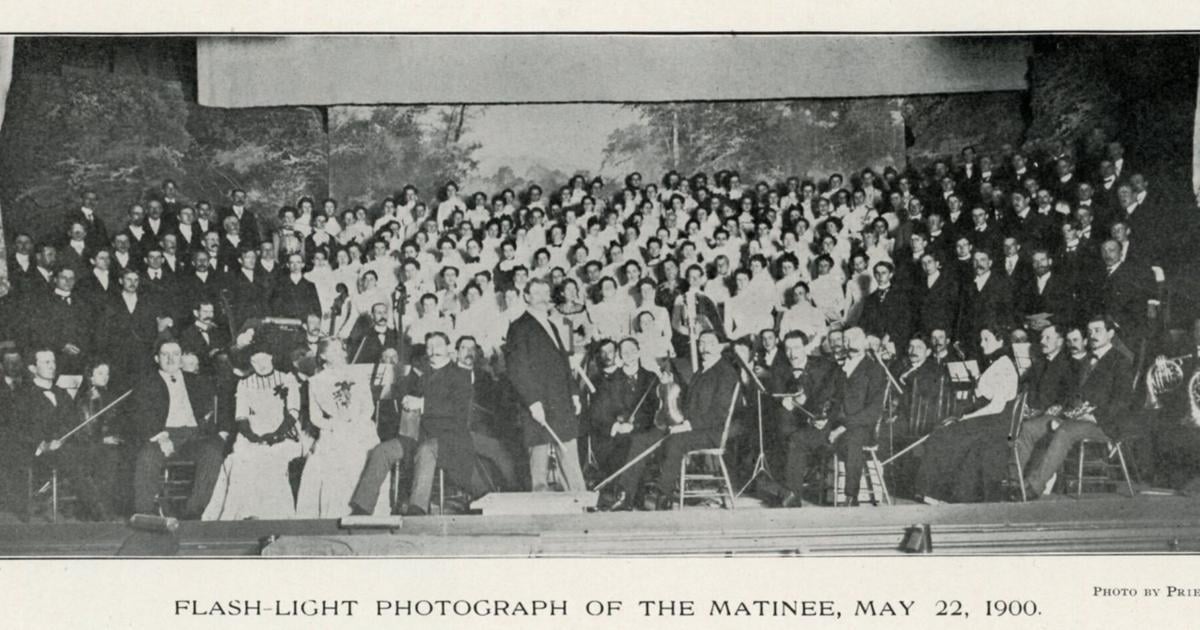
The 16th annual Geneva Music Festival is underway, bringing world-class artists to the city. It’s not the first event to do so; the annual festival of the Geneva Choral Society ran from 1895 to 1923.
While the current festival was started by Geoffrey Herd, Hannah Collins, and Eliott Heaton, the Choral Society was a community organization.
According to a 1903 history, the Choral Society began with a casual conversation. While visiting music professor P.D. Aldrich in Rochester, Mrs. Clapp and Mrs. Moor lamented the lack of a choral society in Geneva. “Professor Aldrich, in his characteristically alert manner, responded, ‘Nothing easier; get forty names, call a meeting, elect your officers and a conductor and behold your society!’”
The first meeting was held May 2, 1894, in the First Presbyterian Church chapel. Forty-five men and women signed as charter members, paying “the sum of two dollars each for a term of ten lessons to be given by Mr. Perley Dunn Aldrich.” Throughout its history, the Society emphasized performance of trained voices. The members’ enthusiasm may be gauged by the fact they held their first concert in late June.
In 1895, the Society held its first annual May Festival. The advertising flier announced, “Greatest Music Festival in the History of Geneva, Grand May Festival to be given by the Geneva Choral Society.” Singers from Rochester and Ithaca joined local members to form the “Grand Chorus of One Hundred and Fifty Trained Voices.” Together with a 20-piece orchestra, the Society presented a matinee and evening performance at the Smith Opera House.
The festival continued every year through 1917. The 1904 program booklet told a story familiar to every local arts organization. “To be sure there have been lean years as well as full ones, years when the Society’s purse has had but a penny left at the bottom … But such serious embarrassments now seem to be past.”
The Society was not without drama. In January 1904 a leaflet, “A Split in the Geneva Choral Society,” was printed by “Friends of Justice and Members of the Geneva Choral Society.” Professor Richard Sutcliffe had conducted the society for a number of years, but an opposing faction wanted to replace him. Sutcliffe was voted out at a board meeting. After outlining the facts, the leaflet concluded: “The chorus are almost solid for Prof. Sutcliffe, and are highly indignant over the action of the Board. A large number have signified their intention to retire and withdraw their pledges unless [he] is retained … the choral society may end in chaos.”
Big names perform
For the first two decades the festival hired regional soloists and musicians, sometimes drawing from New York City. Then it began attracting well-known soloists. A later program history recounted, “In 1914 (the Festival) made a great step forward, and gave its Festival Concerts in the State Armory, realizing that it had outgrown the Opera House which had so long sheltered it. Giving up the orchestra that year, it secured the services of two of the great artists of the world — Mme. Schumann-Heink and Mr. Reinald Werrenrath.”
Reinald Werrenrath (Aug. 7, 1883-Sept. 12, 1953) was an American baritone opera singer. He made hundreds of records, toured extensively and was a regular on radio shows.
Ernestine Schumann-Heink (June 15, 1861-Nov. 17, 1936) was a Bohemian-born Austrian-American operatic dramatic contralto of German Bohemian descent, noted for the flexibility and wide range of her voice. Unlike Werrenrath, she was known for her opera performances.
In 1915 at the Methodist Church, renowned artists Alma Gluck and tenor Evan Williams performed.
Alma Gluck (May 11, 1884-Oct. 27, 1938) was a Romanian-born American lyric soprano. Her initial success came at the Metropolitan Opera in New York City, but she later performed across America and became an early recording artist.
Harry Evan Williams (Sept. 7, 1867-May 24, 1918) was an oratorio tenor. He recorded almost 100 78-RPM records for the Victor Talking Machine Co. in the United States and The Gramophone Co. (His Master’s Voice) in England. Williams, praised for his interpretations of Handel, gave more than 1,000 performances and recitals during his 25-year career across the United States and in England and Wales.
Other artists appearing with the Geneva Choral Society included contralto Christine Miller and tenor Paul Althouse with the Philadelphia Orchestra and Leopold Stokowski in 1916 at the Armory. In 1917, the Chicago Symphony Orchestra performed with Werrenrath who was joined by soprano Grace Kerns. In 1922, the Cleveland Symphony Orchestra appeared with Rochester soloists.
Geneva Daily Times publisher W.A. Gracey organized vocal concerts and festivals. Two artists he brought to Geneva were soprano Alma Gluck and contralto Louise Homer. Both women performed in the Metropolitan Opera but recorded popular songs for Victor. They sang several duets of Christian hymns, including the 1913 recording of “Abide with Me.”
The Gracey collection contains a few scrapbooks solely dedicated to the Choral Society (founded in 1894) and reveals the troubles brought about by the First World War. The group was incredibly popular before the war, but when it had to halt concerts in 1918, its revitalization in 1921 became a flop in 1923. The Geneva community was asked for support, but did not provide enough and the Choral Society was finished.