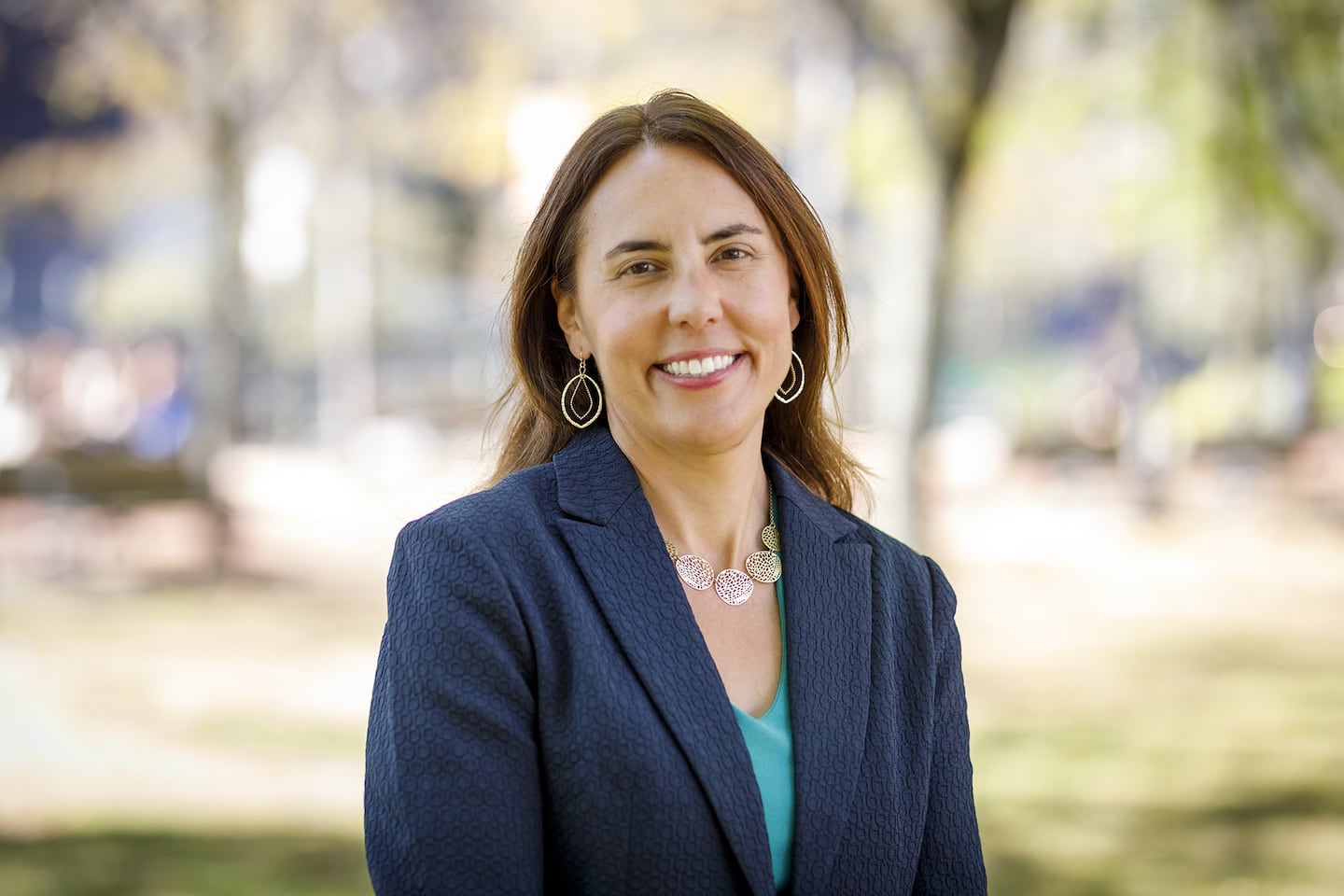
Part of what has kept her at Brown all these years is “the Rhode Island ecosystem,” Beaudoin said.
“I can identify a problem at the bedside of an individual patient, [and] I can zoom way out and turn that into a research question,” Beaudoin said in an interview.
“You can actually turn around and do something about it in our local ecosystem, in our hospitals, with our state agencies,” she added. “And so the smallness of Rhode Island that we often joke about is actually a great strength of being here as a physician and a scientist and academic leader.”
Beaudoin spoke to the Globe about her background, her vision for the school of public health, and the university’s controversial agreement with the Trump administration last year:
Q. Your research and work has centered on pain management and substance use and recovery amid the opioid epidemic. Most recently, since 2021, you have provided “stigma-free addiction treatment” to patients in Woonsocket. How will those experiences and that background shape your approach to this new role?
Beaudoin: For me it’s what grounds the work that we do in the School of Public Health because at the end of the day, it is all about what’s happening to you and me and our neighbors. When we think about public health, it is that higher level — it’s population or groups within a population. And I think the only way that you can inform that high-level strategy is by really having a deep understanding of what is happening at the individual level.
The school has experienced growth and expansion in recent years. Graduate student enrollment is at an all-time high, doubling since 2020. What are some of the factors driving those trends and how can the school build on that momentum?
We are still a relatively young school of public health. We’re about to head into our 14th year, so I think this is a natural part of growth. There’s a real need in our state, and I think within our university, for it to have an independent school of public health, and that growth, I think, is just mapping along with the desire to have the type of work we do. There has also been an incredible demand for public health training for the needs of the workforce.
So, just a lot of, I would say, strategic growth with the school and intentional growth because we’re trying to tackle important problems, and recruiting the right faculty and students to help us do that. I expect that we probably will have a little bit of leveling off or more modest growth, but we still are young and we still have, I think, some areas that we would like to bolster and double down our efforts on within the school.
Last year, Brown University reached this controversial agreement with the Trump administration to restore $50 million in federal research funding. How will that agreement, if at all, factor into your decision making as you work to expand the school’s research portfolio and faculty?
We’re happy that the agreement was reached and that our federal funding was restored. We’re also optimistic about the opportunity for workforce development that also emerged from that agreement, and our faculty have academic freedom to pursue the work that they want to pursue, and that is always going to be the case.
When it comes to federal funding for different research questions, priorities shift all the time. They’ve been more publicized, a bit more noticeable, they’ve been more rapid, probably within this administration than in the past.
But when the federal government is putting out requests for research proposals, they’re basically asking for bids on a contract to answer a research question. It’s up to our faculty to figure out if their work is responsive. There is a real want and need to diversify our revenue streams, because there are some questions that we think are important that need to be addressed that may not be within the scope of what the government is interested in addressing at this time. And in a school of public health, in some ways it’s easy for us, because we are going to go back to that North Star of we are here to improve the public’s health.
An optimistic piece is that Congress appropriated a modestly higher amount of federal funding for health, for biomedical research, in this last appropriation cycle and so I take that to mean that the federal government still prioritizes health. They have shifted some of the things that they want to fund, but we will figure that out, and we’re still going to do the work that’s important.
When you come to the end of your tenure as dean, where would you like this institution to be?
I want us to be a school of public health that is shaping the future of public health rather than responding to it. I think we have an opportunity to set the agenda for prevention, resilience, and population well-being far into the future.
This interview has been condensed and edited.
The Boston Globe’s weekly Ocean State Q&A features Rhode Islanders who are starting new businesses or nonprofits, conducting groundbreaking research, or reshaping the state’s economy. Send tips and suggestions to rinews@globe.com.
Christopher Gavin can be reached at christopher.gavin@globe.com.