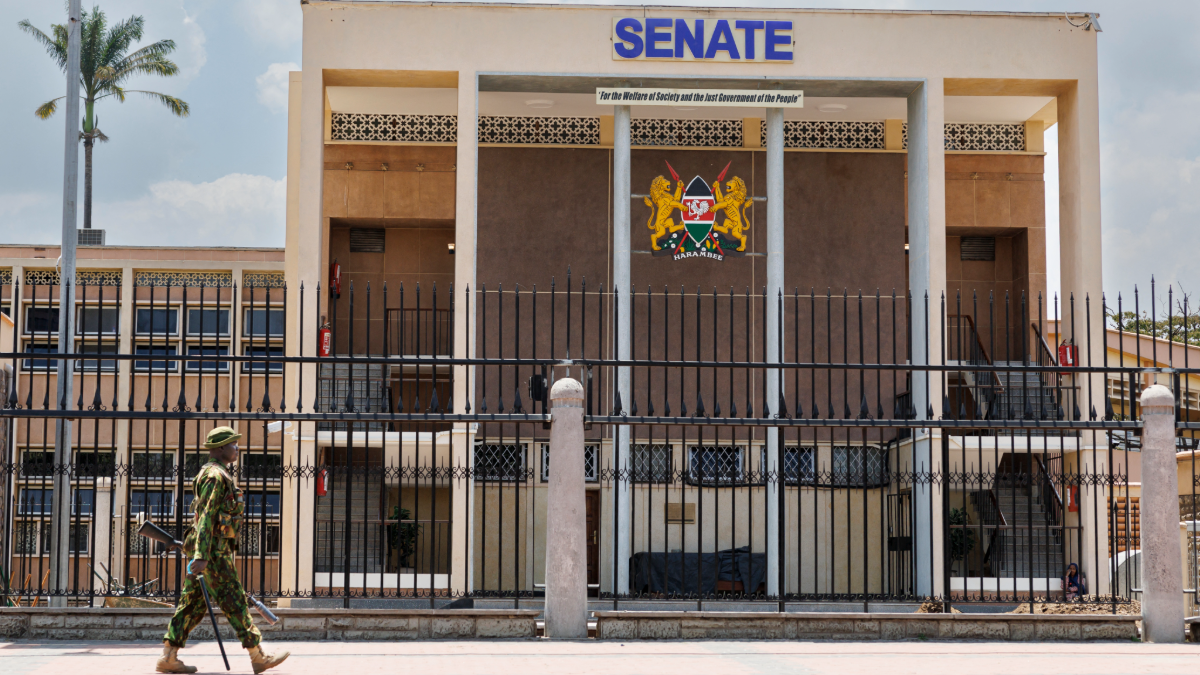
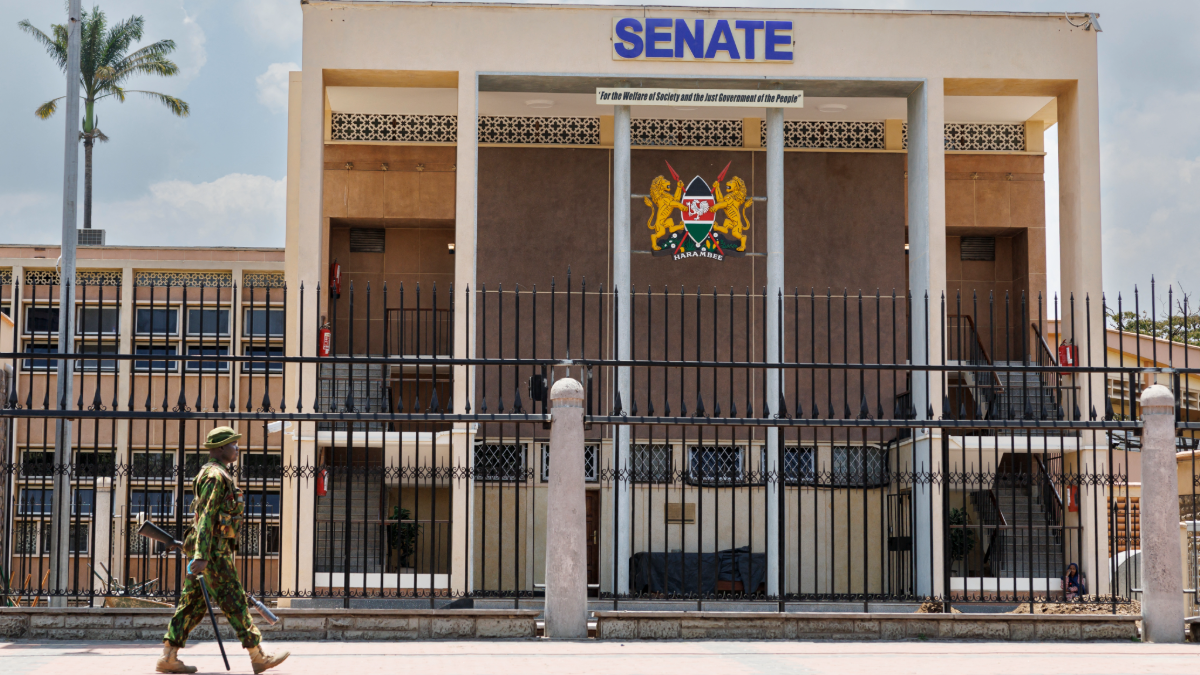
A security officer patrols at the front of the Senate precincts in Nairobi on October 16, 2024. (Photo by Tony KARUMBA / AFP)
A bill to regulate artificial intelligence is under consideration in Kenya’s legislature. The Artificial Intelligence Bill, 2026, received its first reading in Kenya’s Senate on April 2 and has been committed to the chamber’s Standing Committee on ICT, which was, until two weeks ago, seeking public input. The bill is sponsored by a nominated Senator, Karen Nyamu, and does not originate from the Senate’s ICT Committee.
The bill also arrived in the Senate while the Ministry of ICT and KICTAnet were leading multi-stakeholder consultations to develop a national AI and emerging technologies policy, a possible indication that the bill is not informed by that process nor by the AI strategy launched last year, and risks getting ahead of the policy it should be grounded in.
This is not the first time a privately sponsored AI bill has created this kind of misalignment. Most privately sponsored bills tend to be narrowly focused on single issues, sometimes based on politicians’ personal experiences, and therefore miss the country’s digital strategies and constitutional provisions. The Senate is one of the platforms through which citizens can petition the government to act on public issues, but not every policy problem requires a bill, and some may require county governments and relevant house committees to hold sessions with the respective ministries.
Similar to this case, in 2023, the Robotics Society of Kenya petitioned parliament to draft a bill proposing the creation of a body corporate to promote the field, register practitioners, and require persons or entities engaged in robotics and AI businesses to register with the government. The proposed body was essentially a professional society model, closer to how Kenya regulates engineers or accountants than to how the EU AI Act regulates AI systems. The bill was reviewed by the National Assembly’s Communications Committee in early 2024 but faced significant opposition from tech experts who questioned both its approach and scope. Because AI is a technology that spans multiple sectors, the Kenyan tech community was concerned that requiring professionals to register under a society would stifle innovation, which most digital strategies aim to promote. The bill remained in draft form and never made any headway in the legislative process.
The concern now is whether the AI Bill 2026, despite its greater ambition, could similarly undercut the industry-led, government-supported AI strategy and the policy process already underway, and how such proposed bills can be coordinated to ensure alignment with the country’s broader digital strategies.
What the bill does to political expression
The AI Bill 2026 targets political expression through two main provisions. First, a mandatory disclosure requirement: any AI-generated content that resembles existing persons, places, or events must be clearly labelled as such. This reflects a global trend. The EU AI Act requires that AI-generated content, including deepfakes and synthetic text, be clearly marked; China’s Measures for Labelling AI-Generated and Synthetic Content mandate visible markers and embedded metadata; and South Korea’s AI Framework Act, enacted in January 2026, imposes transparency and safety requirements on generative AI. So Kenya is not an outlier in requiring disclosure.
The second instance, and where the problem lies, is where the bill criminalizes creating or distributing deepfakes intended to deceive, defame, or incite violence, with penalties of up to KES 5 million and two years’ imprisonment.
With Kenya’s 2027 general elections on the horizon, the deepfake provisions have a clear rationale. AI-generated disinformation is already circulating in Kenya’s political information ecosystem, including deepfake videos that have targeted government officials, coordinated campaigns that have weaponized hashtags and synthetic imagery, and AI-generated explicit content that has targeted female politicians and activists with the intention to silence them. Apart from AI threats in elections, there are threats related to discrimination, existential threats and so on. Given these dangers, the case for such rules in Kenya is well-established; the open question is how the identified challenges should be addressed.
Problems with structure and free expression
The bill borrows the EU AI Act’s risk classification architecture but does not carry it over into its penalty provisions, which matters because proportionality between risk level and sanction severity is the entire point of a risk-based framework.
The EU AI Act’s penalty structure is deliberately mapped onto its risk tiers, with the highest penalties applying exclusively to violations of prohibited AI practices. The penalty architecture mirrors the risk architecture, and each tier explicitly cross-references the substantive provisions it enforces. Critically, the EU AI Act’s penalties are administrative rather than criminal, are enforced through market surveillance authorities, and include explicit proportionality provisions for small and medium-sized enterprises and startups, applying the lower of the two penalty amounts rather than the higher.
In contrast, Kenya’s AI Bill does not differentiate penalty severity by risk tier and reaches for criminal imprisonment rather than administrative sanctions, even for obligations, such as transparency disclosure, that the EU treats as a second-tier administrative matter. Rather, it groups deploying a prohibited AI system, failing to conduct a risk assessment, and distributing a deepfake without consent under the same penalty ceiling of KES 5 million and two years’ imprisonment. So, a government mass surveillance system and a satirical AI image of a politician can attract the same sentence.
While the EU AI Act has its own flaws, it does provide exceptions for deepfakes that are “evidently artistic, satirical or fictional,” which may face less intrusive labelling requirements. This is a deliberate recognition that not all synthetic media is deceptive and that political satire serves a democratic function worth protecting. Kenya’s bill includes no equivalent carve-out. As a matter of drafting, this gap should be closed through the public participation process. An explicit exemption for satire and civic commentary, aligned with Kenya’s constitutional protections for freedom of expression under Article 33, would strengthen the bill without weakening its ability to address genuinely harmful deepfakes.
It is important to note that the bill comes amid worry among political elites about how Gen Z uses AI for political satire and civic engagement while demanding accountability from politicians. Politicians have expressed concerns in parliament and through roadshow pronouncements, threatening to limit the use of AI in political communication.
The 2024 #RejectFinanceBill protests were the catalytic moment where Kenyan youth creatively deployed AI tools to take on the political establishment, including the “Corrupt Politicians GPT” (a chatbot exposing corruption cases involving politicians) and the “Finance Bill GPT” (which broke down the controversial bill’s provisions and shared lawmakers’ phone numbers for direct constituent engagement). These tools were genuinely civic in character, as some tools translated legislative jargon into actionable information. Other tools include “SHIF GPT” for the Social Health Insurance Fund and “Kenya Law Guide” for constitutional provisions. The bill does not give a clear answer as to whether any of these tools would fall foul of its provisions on AI-generated content that “resembles existing persons.”
People are already being charged under existing law for AI-related political expression, and this pattern warns of what imprecise AI-specific provisions might enable. Benson Ashiko was arrested in January 2025 for sharing a viral post depicting President William Ruto’s funeral and was charged under Section 23 of the Computer Misuse and Cybercrimes Act for publishing false information. David Mokaya, a university student, was charged in 2024 for posting an AI-generated image of a presidential coffin during national protests and was acquitted only in early 2026. Billy Mwangi, a 24-year-old student, was abducted in December 2024 for sharing a similar image. Software developer Rose Njeri was arrested in May 2025 for building a civic AI engagement tool that enabled citizens to email their opposition to the Finance Committee. As much as these actions by the government were meant to stifle activism, they also demonstrate that the country already has laws to criminalize such kind of AI disinformation.
With a growing industry of political influence, AI is being used in multiple directions, and who gets criminalized for using it for expression depends on which side of the political spectrum wields it and against whom.
Let the policy process lead
The 2026 AI Bill has usefully forced AI governance into the legislative conversation. But it should not be allowed to overtake the more deliberate, inclusive, and technically informed policy process already underway. The path forward on how the government can tackle disinformation threats while allowing political expression and innovation by industry can be framed by the AI policy and addressed by interested parties through the multistakeholder process. The Bill can also direct the proposed AI commission to develop specific industry laws in collaboration with media and information stakeholders. As other nations have learned, AI regulation requires careful deliberation.
The views in this article are those of the author and not any organization with which she is affiliated.