A Fanatics advertisement on the sideline billboard during the NWSL match between Houston Dash and Washington Spirit at Shell Energy Stadium on March 14, 2025 in Houston, Texas.
Aaron M. Sprecher | Getty Images Sport | Getty Images
Fanatics is set to displace Panini as the exclusive licensee of FIFA's collectibles in 2031, following an agreement with FIFA over the licensing rights for World Cup soccer collectibles.
The deal would see Fanatics expanding its existing portfolio of licenses, which includes major sporting franchises like the NFL, NBA and MLB, and is set to hand the company a greater foothold in a multi-billion dollar sports collectibles market.
But as Fanatics consolidates its grip on the global sports collectibles market — part of a growing $100 billion sector, according to estimates from Morgan Stanley — its aggressive expansion has attracted legal challenges and accusations of monopolistic behavior.

Fanatical innovation
Under the new FIFA-Fanatics agreement, starting from this year's World Cup, tournament debutants are set to wear "debut patches" on their inaugural matchday jerseys, which will subsequently be removed and distributed as exclusive trading cards once the agreement takes effect in 2031.
The practice began in the 2023 Major League Baseball season, after Fanatics acquired exclusive licenses to produce baseball cards for the league in 2021. While Fanatics' MLB deal was initially slated to take effect in 2025, it took over licenses to the league after acquiring previous licensee Topps in 2022.
The scarcity of such one-of-one debut cards have seen pieces retailing for thousands on online resale platforms like eBay.
The practice of issuing debut cards in trading card packs has since been replicated across franchises like Formula 1 and the NBA — other sports leagues where the now Fanatics-owned Topps previously held licenses.
"With Fanatics, we see that they are driving massive innovation in sports collectibles that does provide fans with a new, a meaningful way to engage with their favorite teams and with their favorite players," FIFA President Gianni Infantino said in a statement on May 7.
Fanatics' other moves in the sports collectibles scene have been underpinned by a similar spirit of innovation.
In 2025, the company's collectibles division opened its first brick-and-mortar store in London's Regent Street — a distinct sales approach, as rivals like Panini and pre-takeover Topps sold products through distributors or online stores.
Trading cards from Panini's FIFA World Cup 2026 Adrenalyn XL collection launched on March 25, 2026.
Bruno Fahy | AFP | Getty Images
Fanatics has also looked to celebrity personalities like Formula 1 driver Lewis Hamilton, who appeared at the opening of its Regent Street store, and social media influencer Logan Paul to drive engagement.
With its FIFA deal, Fanatics is set to take on exclusive collectibles licensing rights to the flagship event of the world's most popular sport.
The 64 games of the 2022 World Cup engaged 5 billion fans across all media channels, with the final between France and Argentina reaching 1.42 billion viewers, according to official figures from FIFA. In comparison, Super Bowl LIX in 2025 — the most-watched sports event in the U.S. — drew around 127 million viewers, Nielsen estimated.
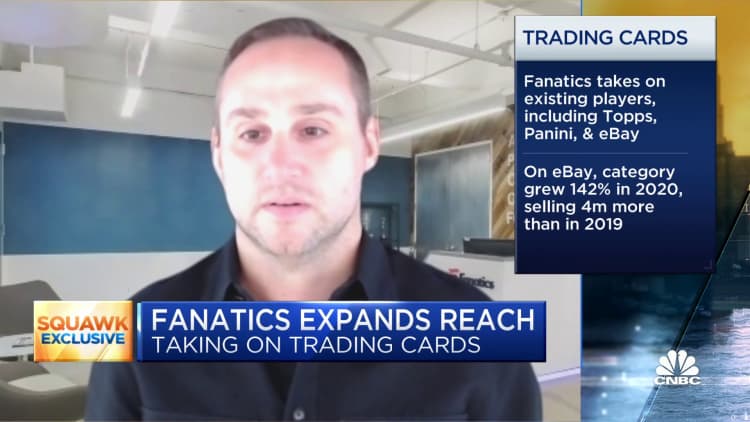
In a May 7 interview with CNBC, Fanatics CEO Michael Rubin said that the company's collectibles division alone was expected to rake in $5 billion in revenue, while the company — which spans merchandising, a sportsbook, a prediction market, as well as an events and entertainment division — was expected to generate $14 billion in revenue.
Troubled waters
But Fanatics' aggressive moves in the collectibles space has also drawn scrutiny.
Prior to its $500 million purchase of Topps in 2022, Fanatics acquired licenses to the MLB, NBA and NFL — all of which were initially slated to begin after the end of Topps' licenses in 2023, 2025, and 2026 respectively.
Many of the sporting franchises licensed to Fanatics also hold equity stakes in the company. In 2022, the NFL led a $1.5 billion round of funding for the company, with a $320 million stake, after its players association agreed on licensing terms with Fanatics the year before.
No such equity terms, however, have been agreed on under the FIFA-Fanatics pact, a source familiar with the matter told CNBC, who declined to be named discussing sensitive matters.
In a March report, the American Economic Liberties Project (AELP) wrote that "the market consolidation by Fanatics has fundamentally altered the merchandise and trading card market for collectors and fans."
"Before Fanatics' acquisitions, competition between Topps and Italian brand Panini drove innovation in card design, quality, and pricing. Now, with Panini's exclusive licenses expired and Topps under Fanatics control, Upper Deck remains the only competitor, and only in hockey," the AELP added.
In 2023, Panini America filed an ongoing antitrust lawsuit against Fanatics over what it claimed constituted an attempt to "monopolize the markets for Major U.S. Professional Sports Leagues trading cards."
"Without redress, consumers will suffer, prices will rise, quality will fall, and innovation will be stifled," Panini alleged in its court filing.
In its report, the AELP similarly found that collectors were reporting "significant price increases for boxes and packs, with some products doubling in cost within a year of Fanatics taking over production."
With the introduction of products of greater rarity — like one-of-one cards — the price of collectibles naturally increases, particularly for highly coveted players.
"Historically, children and families were the core buyers," Ricardo Fort, founder of Fort Consulting, told CNBC in an email. "Today, that remains true for mass-market products, but adult collectors have become a major segment, driven by nostalgia, scarcity, and investment potential."
But while reduced competition could lead to higher prices and fewer choices, a company with broad rights could also invest more in innovation, technology, authentication and global distribution, he added.
In a recent statement to CNBC, Fanatics described Panini's 2023 allegations as "meritless," and added that the company "remains committed to creating the best possible collector experience across the globe." The company, however, declined to comment on broader monopoly claims.
Weakened competition
After its purchase of Topps, Panini and Upper Deck — trading card producer for the National Hockey League — remain Fanatics' most credible competitors.
Although the NHL entered into a 10-year agreement with Fanatics over the production of NHL team jerseys in 2023, the league also inked a "long-term" extension of Upper Deck's trading card licenses, which began in 1990.
In January, Upper Deck also introduced one-of-one trading cards featuring autographed swatches from the game-worn jerseys of league debutants, an initiative similar to Fanatics' debut patch cards.
Apart from FIFA, Panini holds collectibles licenses to franchises like the Women's National Basketball League, NASCAR and LIV Golf.

However, questions hang over Panini's future.
In 2019, Panini America was sued for failing to fulfill requests for "redemption cards" — cards that consumers could exchange for specific autographed copies.
These cards, however, could not be redeemed as Panini had not gotten signatures from the relevant athletes at the time of sale, Larry Centola, attorney from Martzell, Bickford & Centola, and one of the plaintiffs of the lawsuit, told CNBC.
In a call with CNBC, Centola said that the firm alleged that over 10,000 collectors had been impacted by Panini's nonfulfillment of these redemption cards.
Although the case was dismissed after the firm was denied the class action certification it sought — a ruling it chose not to appeal — Centola said he still receives emails from customers with similar experiences — seven years since the lawsuit was first filed.
In October 2025, Reuters, citing sources familiar, reported that Panini had picked Citi as a financial adviser for a possible sale of the company. Citi declined to comment to CNBC on the matter.
"Panini's lawsuit is nothing more than a last-gasp, flailing effort by a company that has lost touch with its consumers and has tried unsuccessfully to sell itself for years," Fanatics wrote in its statement to CNBC.
In 2023, after Panini filed its antitrust lawsuit, Fanatics countersued Panini, claiming that "Panini has become complacent, failing to invest in marketing or innovation as it funnels profits back to its owners in Italy while openly trying to sell its business for nearly a decade." The case is ongoing.
Panini didn't respond to CNBC's requests for comment.
Source link ← Back to News