The unraveling of the politically charged “Broadview Six” case against Operation Midway Blitz protesters began earlier this week when a federal judge agreed to look at unredacted grand jury transcripts to “see if there is anything suspicious” about portions that had been mysteriously removed by the U.S. attorney’s office.
What U.S. District Judge April Perry found was beyond suspicious, according to a transcript of a closed-door hearing released late Thursday. It was shocking.
Before two separate grand juries last year, a federal prosecutor repeatedly stepped over the line, including “vouching” about the strength of the evidence, telling panel members who disagreed with the prosecution’s theory of the case that they could just leave, and having “ex parte” communications with a grand juror outside the proceedings, according to a series of bombshell revelations in court Thursday.
The first grand jury refused to return an indictment, leading to a second panel being convened, the transcript showed. That time, several grand jurors “made comments” and walked out of the proceedings. The testimony of the agent ended abruptly, and they had to start anew the next day to get the indictment.
“Although I am not going to prejudge the issue without a hearing, I will say that I was incredibly shocked by the redactions that were made,” Perry told the assembled parties, according to the transcript. “I have read hundreds, if not thousands, of grand jury transcripts involving prosecutors who are the most junior of prosecutors to several U.S. Attorneys who appeared before the grand jury. I have never seen the types of prosecutorial behavior before a grand jury that I saw in those transcripts.”
Perry also said there was a “potential” for “sanctions for prosecutorial misconduct and for potential ethical violations, including lack of candor to the court,” the transcript showed.
The stunning developments led U.S. Attorney Andrew Boutros to announce in court that he was dismissing all remaining counts in the case, which had been scheduled to go to trial on Tuesday.
Boutros also issued a remarkable and lengthy apology to the court, saying he had only found out about the problems in the grand jury last month and made a quick decision to drop the felony conspiracy charge.
“I will tell your honor that as upset as you are, and have been, I too had not seen conduct like that, and it upset me which is why we did dismiss that indictment,” Boutros said after moving to dismiss the leftover misdemeanor counts.
Boutros also defended the current prosecution team, saying they believed the redactions initially made in the grand jury materials were complying with Perry’s order to turn over only portions dealing with the instruction on the law.
“No one acted with the intent to mislead your honor, and I think that they were following your order to give the law,” Boutros said.
After his apology, however, Boutros defended the bringing of the case, saying what occurred in Broadview on Sept. 26 was “unacceptable in a civilized society” and that it was “for the grace of God” that that agent drove his vehicle slowly through the crowd and didn’t jump out and shoot anybody.
That clearly irked Perry, who said to Boutros flatly: “You are significantly undercutting your mea culpa here by standing behind the charges and continuing to vilify these particular defendants.”
Perry said she intends to hold a hearing on possible sanctions for the U.S. attorney’s office’s actions in the case, but did not set a timeline. The immediate concern, Perry said, was for the defendants.
“Hopefully they never have to come back to this building again, unless it is voluntary,” the judge said.
At the suggestion of the defense, Boutros agreed to remove from the U.S. attorney’s office website the press release put out on the day the case was brought, or otherwise add a banner noting that the charges had been dismissed.
The day’s remarkable events — described as unprecedented by many courthouse veterans — marked the final collapse of what had been one of the marquee criminal cases to come out of Operation Midway Blitz.
It now joins a slew of other immigration-related cases to blow up for the U.S. attorney’s office here, including several where a grand jury refused to indict, others that were dismissed ahead of trial, and one where a jury acquitted a defendant after just three hours of deliberation.
While defense attorneys applauded Boutros for dropping the charges Thursday, they also accused the U.S. attorney’s office of embarking on a monthslong cover-up of what had happened in the grand jury, first dismissing the conspiracy count and later turning over only partial portions of the transcripts to the judge.
Attorney Christopher Parente, a former federal prosecutor who represents Oak Park Trustee Brian Straw, said he had “never even heard of something as bad as what took place in this grand jury session,” but that in some ways the “cover-up” was worse.
“We’re talking about continued misconduct by the U.S. attorney’s office, which continued the prosecution that cost these individuals significant attorney’s fees, significant stress … for what?” Parente told reporters in the lobby of the Dirksen U.S. Courthouse. “I’m sick to my stomach as a former prosecutor. I’m sick to my stomach as a U.S. citizen who has to live in this country with this Department of Justice that is acting this recklessly.”
Nancy DePodesta, the lead attorney for defendant Michael Rabbitt, said she believed the U.S. attorney’s office “intentionally redacted portions” of the grand jury transcripts to keep the court from learning the truth.
“It is shocking. It is absolutely shocking,” said DePodesta, also a former federal prosecutor.
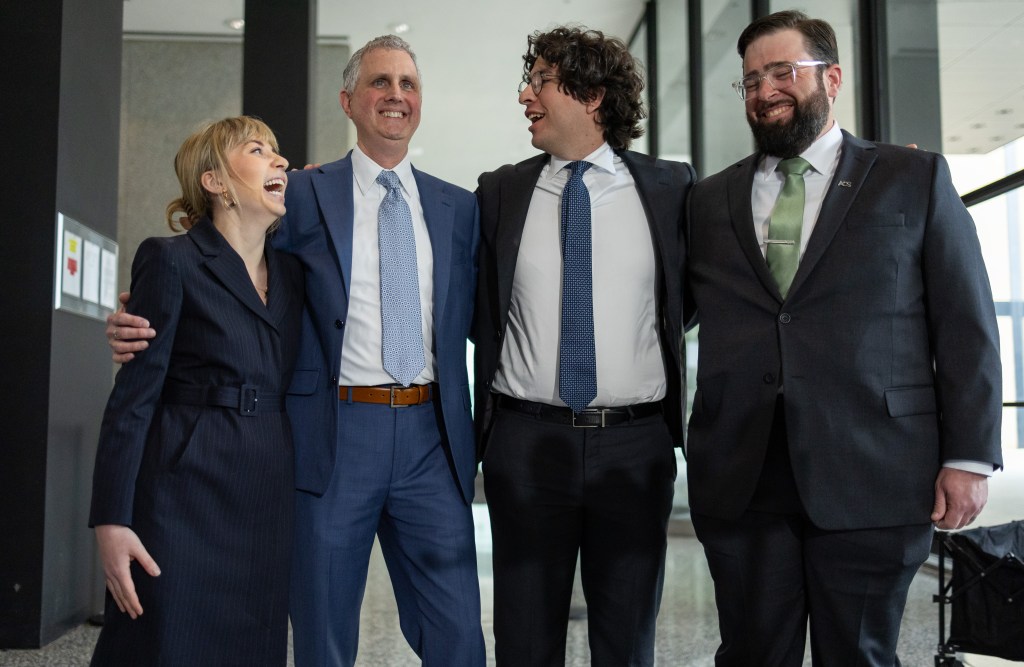
After the hearing, defendant Katherine “Kat” Abughazaleh, a former Democratic congressional candidate, hugged her counsel and colleagues with tears in her eyes. She told reporters that the way her case played out illustrated why they were out in Broadview fighting back in the first place.
“This administration does things like this because it thinks it can silence us, but it’s not going to work,” Abughazaleh said. “We fought back and we won.”
That sentiment was echoed by her fellow former defendants, who have grown close over the past four months and headed over to a tavern near the courthouse afterward to celebrate.
The “Broadview Six” case has been beset by controversy from the moment the indictment was brought in October as the defense alleged the case was brought amid pressure from the administration of President Donald Trump and was nothing more than an attempt to silence protesters of the president’s draconian immigration policies.
Charged in the case were Abughazaleh, 27, who came in second in the March Democratic primary for Illinois’ 9th District congressional seat; Andre Martin, 27, who was Abughazaleh’s campaign manager; Rabbit, 62, the 45th Ward Democratic committeeman; and Straw, 36, who in addition to being a Democratic trustee is also an attorney.
Earlier this year, Perry granted a request from the U.S. attorney’s office to dismiss charges against Catherine Sharp, a onetime candidate for the Cook County Board, and Joselyn Walsh, a part-time garden store worker and singer.
Prosecutors had alleged the defendants were part of a group that surrounded an ICE vehicle outside the Broadview facility during a Sept. 26 protest and “banged aggressively” on the vehicle’s side and back windows, hood and doors before they “crowded together in the front and side of the Government Vehicle and pushed against the vehicle to hinder and impede its movement.”
They further alleged that the protesters scratched the vehicle’s body, broke a side mirror and a rear windshield wiper and etched the word “PIG” into the paint — though no one was ever accused of specifically causing that damage.
The case was indicted with much fanfare but soon showed signs of cracking. The original prosecutor who had led the grand jury, Sheri Mecklenburg, left the U.S. attorney’s office in February for a job with the U.S. Senate Judiciary Committee in Washington, D.C. Reached by phone Thursday afternoon, Mecklenburg declined to comment.
Weeks after she left, all charges against two of the defendants were dismissed. And in April, prosecutors announced the lone felony conspiracy count was also being cut.
As the suddenly low-level case wound its way toward trial, with jury selection set to begin after Memorial Day, Perry whistled prosecutors into court to explain redactions made in the transcripts at the heart of felony conspiracy charges that were abruptly dismissed last month.
The 45-minute session was held in a courtroom closed to the public, with the hallway roped off to keep people from peering in. According to the transcript of the discussion, Perry said the most “problematic” aspect to her was how prosecutors had redacted the transcripts in a way to conceal from her what had happened in the grand jury.
“Mistakes happen. They happen to all of us,” Perry said. “But as I tell my children, you own it. You admit to it. You apologize for it, and you move on. What you do not do is hide it.”
Back in open court, Perry gave prosecutors until 1 p.m. to return to her courtroom to give their position on what portions of the material should remain under seal going forward.
When the hearing reconvened in open court, Boutros stepped up to the lectern and delivered his extraordinary remarks about his office’s handling of the case. When he announced they were dropping the charges, Abughazaleh let out a yelp of surprise.
Several of the defendants were in tears after the hearing adjourned. In the lobby, Abugazaleh, a social media activist who typically is never at a loss for words, said she was so stunned by the development she’d made no prepared remarks. “I genuinely didn’t think it would get dismissed today,” she said.
Her suddenly former co-defendants also spoke about the pain of having the charges hanging over them for seven months, not only emotionally but also in attorney’s fees and time preparing for a trial that now will never happen.
“I will never get the past seven months of my life back,” Straw said.
Attorney Molly Armour, who represents Abughazaleh, said they were confident the jury would have acquitted their client. “The real tragedy was the fact that we were not able to show the public the absolute nonsense of this case,” she said.
Abughazaleh’s other attorney, Josh Herman, who has represented clients in many large national security cases including terrorism charges, said he had never seen “such a warped approach to a case” as the Broadview Six, which alleged a conspiracy “that was bogus from the start.”
“For a misdemeanor charge to have this severity of misconduct? It is a cover-up of what was happening and it is a cover-up that continued today,” Herman said. While he credited Boutros for dismissing the case, Herman said “it only came true when Judge Perry put her foot down.”
“If she had not done that we would be going to trial and this cover-up would have continued,” Herman said. “They finally knew they had run out of road. They finally knew that the time had come, that they could not make more excuses, they could not play games, they could not splice words like they had been doing up until this point.”
Originally, the defense had asked the judge to look at only portions of the transcripts that showed how the grand jury was instructed on the law. After those versions were filed under seal, Perry later ordered prosecutors to bring the full, unredacted transcripts to her chambers at the next hearing.
At that April 29 hearing, however, Assistant U.S. Attorney William Hogan announced his office was dismissing the original felony conspiracy charge and proceeding on misdemeanors, rendering the grand jury transcripts “moot.”
Perry agreed, and after some discussion about next steps, Hogan asked her: “Do you still want us to furnish the unredacted versions or should we wait?”
“Let’s wait,” Perry responded.
“Thank you,” Hogan said.
But Parente continued to press the issue, suggesting the U.S. attorney’s office dismissed the indictment because of some error before the grand jury that they were now trying to avoid disclosing.
The back-and-forth escalated last month when Parente raised the possibility that the U.S. attorney’s office had misinstructed the grand jury on the law or had “improper or prejudicial” interactions with the panel, then dismissed the conspiracy count to avoid having to turn over unredacted transcripts of the proceedings.
In response, prosecutors blasted Parente for “histrionically” speculating about perceived misconduct in what was the normal practice in Chicago’s federal court. “There was nothing remotely unusual, let alone nefarious, about that state of affairs,” prosecutors said.
After Parente again raised it at a pretrial hearing on Monday, Perry on Monday agreed to take a look at the transcripts to “see if there is anything suspicious” about the 30 or so lines that had been redacted, though she guessed at the time that most of the redactions had to do with “IT issues.”
In court Thursday, Parente accused prosecutors of intentionally misleading Perry by not correcting her belief that the redactions were no big deal.
He also referenced an email exchange he’d had with Hogan as the issue was heating up earlier this month. On May 6, he wrote to Hogan: “Bill, in case the court disagrees with your mootness argument tomorrow, could you bring at least one copy of the unredacted transcript to court?” according to a copy of the exchange provided to the Tribune.
Hogan responded eight minutes later with a single word:
“No.”
Source link ← Back to News