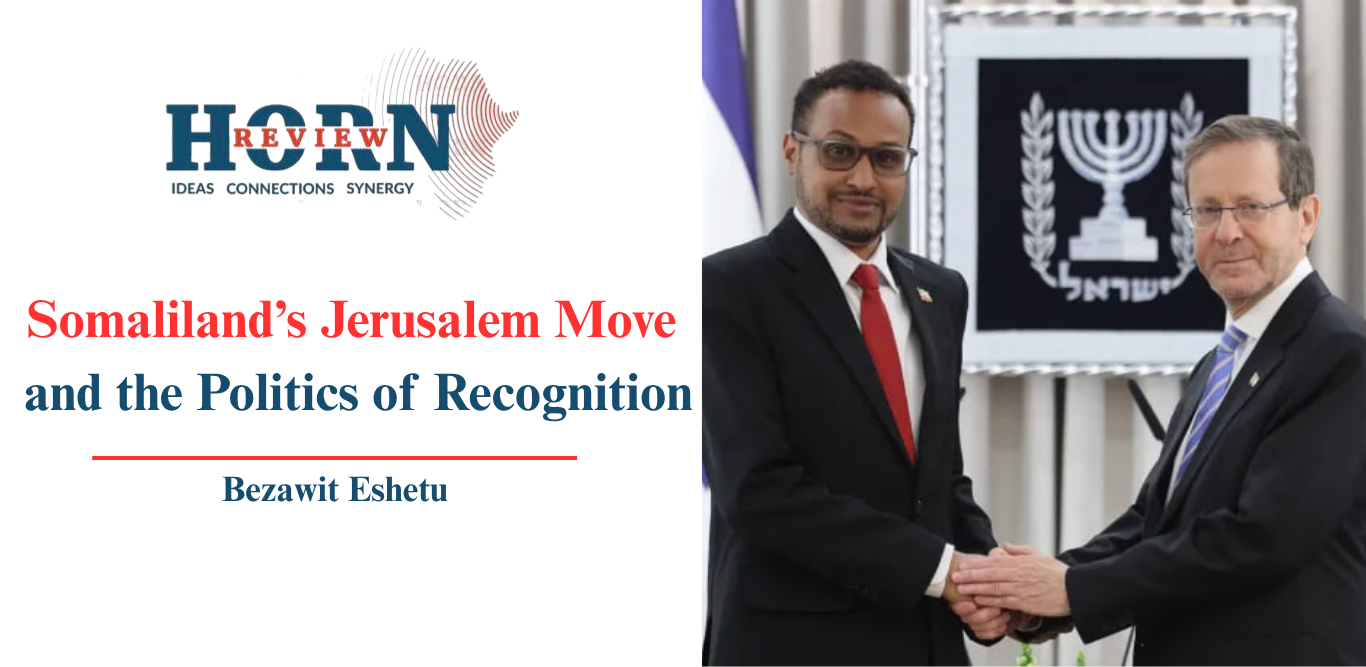
In May 2026, Somaliland made a major diplomatic move by announcing that it would open its first embassy in Jerusalem. In doing so, it would become the eighth country to locate its primary diplomatic mission there. The appointment of an ambassador and the formal presentation of credentials marks the end of Somaliland’s 35-year diplomatic isolation. Since 1991, Somaliland has functioned as a de facto state, complete with its own institutions, currency, military, and competitive elections, yet it remains outside the international legal system. The central question raised by this decision is whether short-term diplomatic visibility and practical gains are worth the longer-term costs of regional alienation. By choosing Jerusalem rather than Tel Aviv, Somaliland is making a deliberately transactional move, exchanging symbolic legitimacy for immediate strategic returns.
This choice also reflects a broader reality in Israeli diplomacy: new high-level partnerships increasingly come with Jerusalem as the price of entry. The limited group of states with embassies there, including the United States, Guatemala, Honduras, Kosovo, Papua New Guinea, Fiji, and Argentina, does not share a single ideology or regional background. What they do share is a strong dependence on specific bilateral ties, often rooted in security, development, or US-backed diplomatic arrangements. In Kosovo’s case, for example, normalization carried clear political value. Somaliland appears to be applying the same logic, concluding that an embassy in Tel Aviv would attract far less attention and yield fewer strategic benefits than a mission in Jerusalem.
To understand the risks of such a decision, the 2018 relocation of the US embassy to Jerusalem offers a useful reference point. At the time, many expected the move to destabilize Middle Eastern diplomacy. In practice, however, that did not happen. The reaction from Arab states suggested that Jerusalem is often treated less as an absolute ideological red line than as a flexible political instrument. For many regimes, the Palestinian issue has long served as a domestic pressure valve: a way to channel public frustration outward, manage opposition, and reinforce regime legitimacy.
This pattern can be traced from the Nasser era onward and later in Egypt, where limited space for protest allowed Islamist groups to absorb political pressure. In that sense, the strong condemnations in 2018 were largely performative, even as several of those states deepened covert security coordination and economic ties with Israel, a trajectory later formalized through the Abraham Accords. Seen from this angle, the reaction to Somaliland follows a familiar pattern.
Across the region, the Jerusalem issue is frequently invoked less as a matter of genuine political commitment than as a tool of domestic legitimacy. Iran uses it to expand influence across the Sunni world and frame its proxy network, while Hezbollah uses resistance rhetoric to justify state capture in Lebanon and obscure its role in Syria. Turkey, too, has used the issue to project itself as a defender of Islamic causes, despite producing limited practical results. From this perspective, the backlash against Somaliland is part of a broader pattern of political theater rather than a unique diplomatic rupture. Hargeisa’s decision, by contrast, reflects a realist calculation: in a system shaped by utility and leverage, symbolic alignment matters less than tangible security and diplomatic returns.
The deeper rationale also lies in the Red Sea security environment. Somaliland’s coastline gives Israel a potential operational foothold near Berbera, where it could help monitor smuggling routes and improve missile-detection times across the Bab el-Mandeb corridor. That would place Somaliland within a wider counter-proxy security architecture and increase its strategic value as a guardian of global maritime trade routes. Supporters argue that this utility could strengthen the case for eventual recognition. The relationship also has domestic value, since Israel brings expertise in desalination and health technology, both of which could deliver visible gains for Somaliland’s population.
Critics, however, argue that this alignment increases vulnerability by straining ties with Somalia and limiting broader recognition. They contend that Somaliland would have been better served by remaining unrecognized for longer rather than forming a Jerusalem-based partnership that may prove politically costly. The concern is that the move could alienate the very regional actors most likely to support recognition. But this criticism often assumes ideological consistency where there may be none. The UAE already maintains deep ties with Israel through the Abraham Accords and continues to treat Somaliland’s leadership with high-level protocol. If Abu Dhabi does not immediately follow Somaliland’s lead, the reason is more likely strategic caution than any principled objection to Israel or Jerusalem.
The reluctance of prospective allies is better understood as a function of layered realpolitik rather than ideological opposition. Emirati caution is shaped by competition over Red Sea ports, a desire to preserve influence across the Horn of Africa without provoking a rupture with Mogadishu, and the need to manage rivalry with other Gulf actors. If other states do not immediately follow Israel’s lead, the reason is not a principled rejection of Hargeisa’s decision but the operation of regional calculations. In that environment, Mogadishu’s pan-Somali objections carry limited practical weight.
The broader strategic reality is that capability now matters more than rhetoric. Somaliland controls its territory, institutions, and coastline, while Mogadishu remains dependent on external assistance even to secure its capital. In that context, Somaliland’s decision to leverage its strategic position in exchange for a powerful patron is not simply a sign of increased vulnerability; it is also a way of forcing the international system to confront its de facto statehood on practical, rather than formal, grounds.
That said, a direct comparison between Somaliland’s move and the 2018 US embassy relocation overlooks an important structural difference. The United States has overwhelming economic and military depth, which allows it to absorb diplomatic backlash without major operational risk. Somaliland has no such buffer. That difference matters because, in Somaliland’s case, a symbolic diplomatic shift is not merely a matter of optics; it can reshape the security environment itself.
As Berbera becomes more central to Somaliland’s external partnerships, it also becomes more clearly a strategic asset rather than only a commercial port. Its position on the Gulf of Aden gives it importance well beyond Somaliland’s borders, and its growing economic and diplomatic visibility makes it more sensitive to regional rivalry and insecurity. For a territory that has built its own institutions but still lacks the security depth of a larger state, that visibility is both an advantage and a vulnerability. The same move that strengthens Berbera’s relevance also makes it part of a wider geopolitical contest.
That is why the diplomatic logic behind Somaliland’s outreach should be read in the same context. Under the Montevideo standard, statehood rests on a permanent population, defined territory, government, and the capacity to enter into relations with other states, and Somaliland has a credible argument that it meets those criteria in practice. It has also sustained de facto self-rule for more than three decades and continued to hold competitive elections, including the 2024 vote that produced another peaceful transfer of power.
From Somaliland’s perspective, this is exactly why passive waiting has not delivered recognition: it has governed itself for years, but the international system has still treated formal recognition as if it mattered more than political reality. In that sense, the Jerusalem move is best understood as a deliberate attempt to turn existing state-like practice into diplomatic leverage.
By Bezawit Eshetu, Researcher, Horn Review
Source link ← Back to News