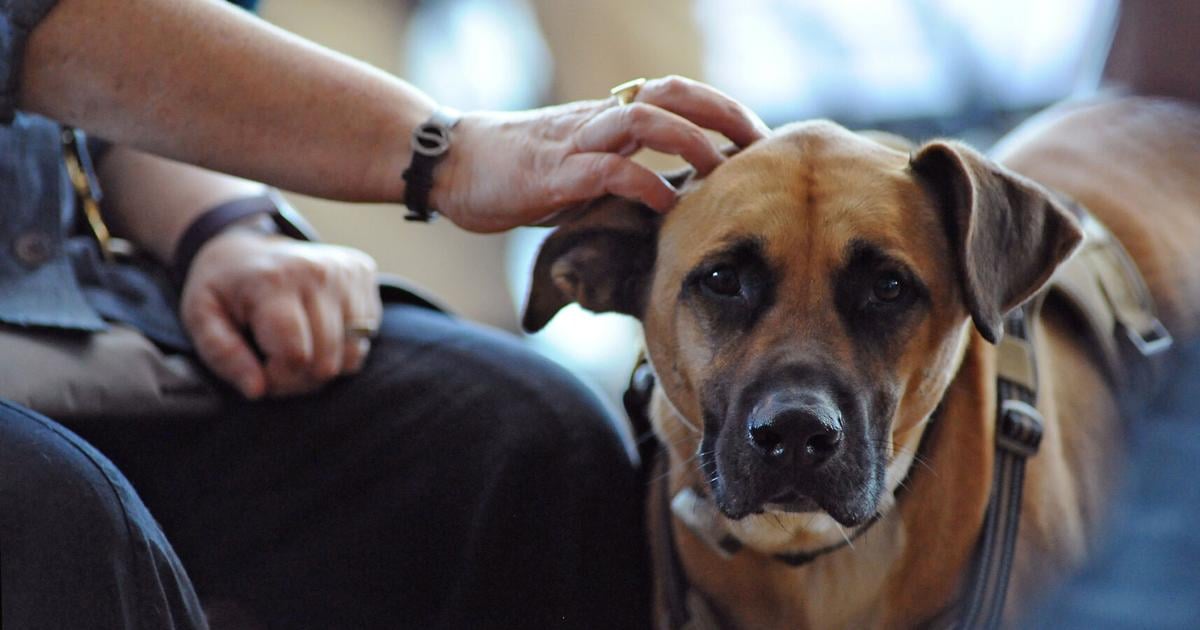
Former Pennsylvania State Trooper Alex Douglass, who lost a leg after being shot by a sniper 12 years ago, will be with his service dog, Peter, at VFW Post 7324 in Ocean View on Friday, May 29, for Hearts & Heroes, a Service Dogs Saving Lives event.
Planned for 6 to 10 p.m., it was designed to “unite hearts, health and lives one paw at a time” and focus on raising awareness and funding for veterans and first-responders struggling with mental health challenges, including those considering suicide.
Douglass, of Olyphant, Pa., will talk about how the 8-year-old golden retriever — who joined the family in 2019 and goes everywhere with Douglass — helps him stay calm when he’s anxious and even delivers the television remote.
“He is trained to get the remote control. He brings it to me in his mouth, with slobber on it, but he does his job,” a laughing Douglass told the Coastal Point during a telephone conversation this week.
In 2014, Douglass explained, a man he called “a deranged individual,” hiding in the woods across the street from the Pennsylvania State Police’s Blooming Grove Barrack in Pike County, Pa., and who had planned to assassinate as many troopers in uniform as he could, shot Cpl. Bryon Dickson, who later died.
“He was expecting more uniformed state troopers to walk out of the building. I was down in the lower parking lot, and he didn’t see me. I came up from the side of the building. As I got over to Cpl. Dickson, to try to drag him to safety, he shot me. The bullet went through the left side of my back, through my pelvic area, out my right hip and femur. I lost my right leg,” Douglass said.
The bullet shattered his pelvis, right hip and right femur.
The amputation was done later, after doctors tried to save the leg, but the delay gave him time to prepare himself for the change, said Douglass — now 43, married and raising his two-stepdaughters with his wife.
The sniper, later identified as Eric Frein, ran into the woods, and a manhunt ensued. He was caught after walking for 48 days, making it nearly 50 miles from the scene. Police found him and took him back to the station. After a trial, he was sentenced to death, but because the State of Pennsylvania doesn’t impose the death penalty, he remains in jail, Douglass said.
Valor Service Dogs, based in Tampa, Fla., later contacted Douglass and asked if he was interested in a service dog.

Service Dogs Saving Lives
“They ended up giving us a dog, but Service Dogs Saving Lives donated the money to raise and train the dogs. It’s very beneficial and very helpful,” he said.
“I take him everywhere. He really calms me down — not just me, but the whole family. The girls and everything. He alleviates the PTSD. He is very helpful with mobility. Even if I’m in a wheelchair, he is right by me. He is very affectionate. He sleeps with me. He knows my signs. If I start getting anxiety, my leg will bounce back and forth. He will come over and put his head on my leg. Or, sometimes I am fiddling around with my hands, and he’ll nudge my hands,” Douglass said, adding that Peter likes to play ball and swim in the family pool.
“I was never suicidal, but the dog and that organization that donates has saved a lot of lives,” said Douglass, who was 31 when he was shot and who has now retired and has a new career as a public speaker, telling his story, and is considering writing a book.
Training costs about $25,000 per dog, and the animals can be lifesavers for those with severe problems, Service Dogs Saving Lives Communications Director Mary Louise Embrey said about the organization as she invited the public to the May 29 event, which will feature a buffet dinner, live entertainment and remarks by Douglass. The cost is $75 per person. To attend, register by Friday, May 22, at www.SDSLHope.org.
Service Dogs Saving Lives “values prevention and the use of highly trained service dogs as a successful life-saving tool,” she said.
The dogs learn 15 to 20 commands to help those with post-traumatic stress disorder and other struggles.
“It is very advanced training. These dogs sense the onset of flashbacks. Having them in the home gives purpose for the person and also helps the whole family,” Embrey said. “After all those hours of training, the dog knows how to fit into the family and make everyone more comfortable and not worrying as much about the person with the struggles because they have that lifelong companion.
“There is a succession plan, too, because dogs don’t live as long as people. I like the catchphrase, ‘The organization has a narrow lane of focus with a wide lane of need.’ We have narrowed the focus for these groups and have these dogs trained for prevention of suicide,” Embrey said.
“We have a unique mission to alter the staggering data of lives lost to suicide. There were over 49,000 in 2022, nationwide, dying of suicide,” she said. “We raise funds for highly trained service dogs assigned to veterans. … The other group we dedicate these dogs to are first-responders. More die by suicide than in the line of duty. We have had veterans tell us they have a family, but the dog will save their life,” she said.
Source link ← Back to News