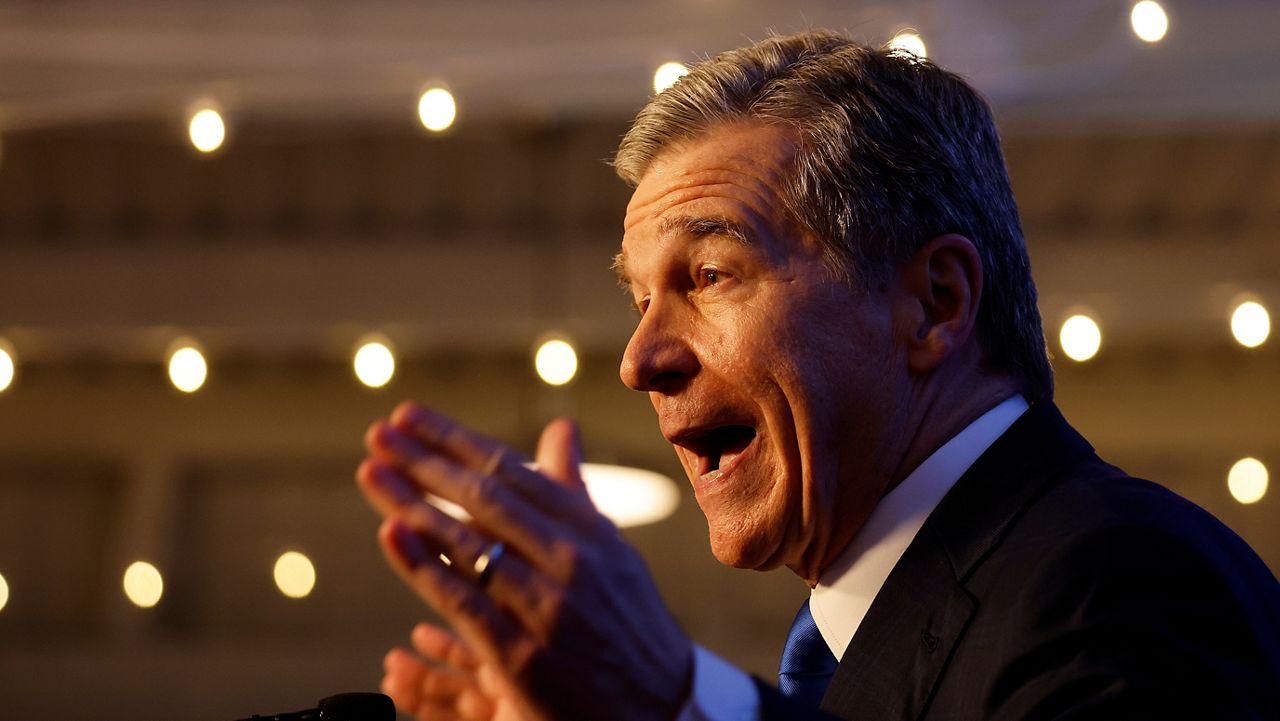
North Carolina Senate candidate Roy Cooper is supporting a ban on former lawmakers becoming lobbyists.
“Elected officials should focus on lowering costs and delivering for the people they represent, not gaming how they will cash out on their connections when they leave office," the former governor said in a statement first shared with Spectrum News.
"Elected officials and high-ranking executive branch staff shouldn’t lobby after they leave office," he said.
Spectrum News reached out to Republican Michael Whatley’s campaign to ask whether he supports a ban, but has not heard back.
The announcement comes after a bipartisan bill to implement a lifetime ban on former members of Congress lobbying was introduced last week by Democratic U.S. Sen. Elizabeth Warren and Republican U.S. Sen. Rick Scott.
“Our founders never intended public service to become a training ground for a lifetime of lobbying. Senator Warren and I are working to end this practice once and for all,” Scott said in a press release announcing the legislation.
The lobbying pipeline
Hundreds of ex-lawmakers have parlayed their work as legislators over the years to become highly paid lobbyists.
“Many of them want to leverage their skills from being in elected office and this can be a pretty lucrative path once you depart the chambers,” said OpenSecrets executive director Hilary Braseth.
Nearly 40% of the members who left Congress at the end of 2024 have moved into lobbying or lobbying-related jobs. That’s up from 27% when the previous session of Congress ended in 2022, according to numbers sent to Spectrum News by research group OpenSecrets.
The ex-lawmakers represent industries including pharmaceuticals, insurance and energy.
“Estimates suggest they can earn as much as a million dollars a year. That’s significantly more than the $174,000 salary of a rank-and-file lawmaker. And those who served in senior positions or led high-profile committees could make even more,” Braseth said.
Spectrum News examined the lobbying disclosure reports of dozens of former lawmakers. The filings detail their clients and how much those clients are paying to lobbying firms.
Spectrum News zeroed in on two former senators whose reported lobbying work appeared fairly representative.
Former Republican Sen. Richard Burr of North Carolina reported lobbying for 18 clients last year, including Duke University, UNC Chapel Hill and the Atlantic Coast Conference as a principal policy adviser at the law firm DLA Pepper.
The reports do not list Burr’s salary, only that his 18 clients paid his law firm $3.7 million for work Burr and other lobbyists performed.
The filings show former Sen. Joe Donnelly, a Democrat from Indiana, lobbied for the Southeastern Conference, the Japan Business Federation “Keidanren” and four other clients as a senior consultant at the law firm Akin Gump.
Together those clients paid Akin Gump nearly $1.2 million in lobbying fees.
Spectrum News reached out to both former lawmakers for any additional statement and their thoughts on a lobbying ban but has not heard back.
Why firms hire ex-elected officials
The benefit of hiring former lawmakers as lobbyists is that they bring their relationships with lawmakers and staff on Capitol Hill, as well as their institutional knowledge.
But the concern is lawmakers can use their time in office to cash in as lobbyists when leaving.
It’s one reason former lawmakers and senior congressional staff are banned from lobbying Congress for a cooling off period. That period is one year for House members and two years for senators. There is no such cooling off period to lobby the White House.
Many former lawmakers, though, don’t formally register as lobbyists, instead working in related jobs.
“This tiny but big loophole called strategic adviser perhaps shoots that cooling off period in the foot,” Braseth said.
Potential outlook for bill to ban the practice
The legislation to implement a ban is unlikely to move forward in the current session of Congress.
“It’s a messaging vote. Probably the people that even filed it don’t even want it to pass,” Republican U.S. Sen. Thom Tillis told Spectrum News. “I get so sick of these things that people file that have no intention of moving.”
Tillis, who is not running for re-election but has said he won’t register as a lobbyist, added
“there is a cooling off period and how can you perpetually eliminate somebody from taking on some other line of work.”
But with trust in Congress at just 17%, according to Pew Research, pressure for passage could increase.
Source link ← Back to News