Oregon State University is working toward its commitment to student and employee wellbeing by becoming the first Oregon university officially committed to be a Health Promoting University. In a ceremony on Wednesday, May 20, university officials adopted the Okanagan Charter to make this commitment official.
Image
Key characteristics of health promoting universities include creating spaces that encourage healthy lifestyles, including access to healthy food, opportunities for physical activity and mental health resources. Health education and community engagement are also key to health, as well as research and innovation that advance knowledge of evidence-based practices. Inclusive policies are also essential, as they support the diverse needs of the university community and acknowledge and honor the individual needs of community members.
The charter calls on post-secondary schools to embed health in all aspects of campus culture and to lead health promotion and action locally and across the globe. As a health promoting university, Oregon State has committed to fostering practices that will enhance the physical, mental and social wellbeing of community members across its locations.
The expectation of being a health promoting university means embedding health and wellness practices into all of the university’s core businesses and practices. Existing examples of creating a healthy campus include offering Faculty Staff Fitness classes since 1984, committing to carbon neutrality and offering the Mind Spa at CAPS, a private relaxation space to destress.
“What you are seeing reflects an intentional and coordinated approach to health and wellbeing across the university and the community,” said Dan Larson, vice president for student affairs. “Health and prosperity go hand in hand and there’s a direct connection to our mission, our values and our strategic plan, Prosperity Widely Shared. And it speaks to the strong collaboration already happening across OSU, across Oregon and beyond.”
University of Alabama at Birmingham was the first university in the United States to sign the Okanagan Charter in 2015, and since then a large cohort of universities have joined the network. One advantage of being part of the cohort the access to the resources and learned experience of other health promoting universities to adapt some of their ideas and programs to Oregon State, where appropriate.
Allison Myers, associate dean of Extension and Engagement, College of Health and one of the HPU co-leads, said Extension has been a key part of health engagement at OSU for more than a century.
"Our Health Extension programs are proud to carry on the work we have long been doing, in service of Oregonian's health and wellbeing,” Myers said. “The Extension Service is trusted to bring health promotion programs to all 36 counties, and becoming a health promoting university is a catalyst for continued collaboration, synergy and impact."
Kelly Hower leads health and wellbeing efforts at OSU and was one of the leaders of the HPU effort over the last two years.
“Health promoting universities are called to two high-priority actions; to embed health in everything that we do and to lead health promotion locally, nationally and globally,” Hower said.
“Together, we are mobilizing systemic, whole campus action to strengthen our community and bring conditions for health and well-being across the state and the globe. What it all comes down to are the people in this room building connections with one another and doing the hard work.”
President Jayathi Murthy explained that this is not a new direction for OSU before she signed the Okanagan Charter.
“However, this marks a clear expression of who we are, a land grant university dedicated to sharing discovery and improving lives across communities in Oregon and beyond,” she said.
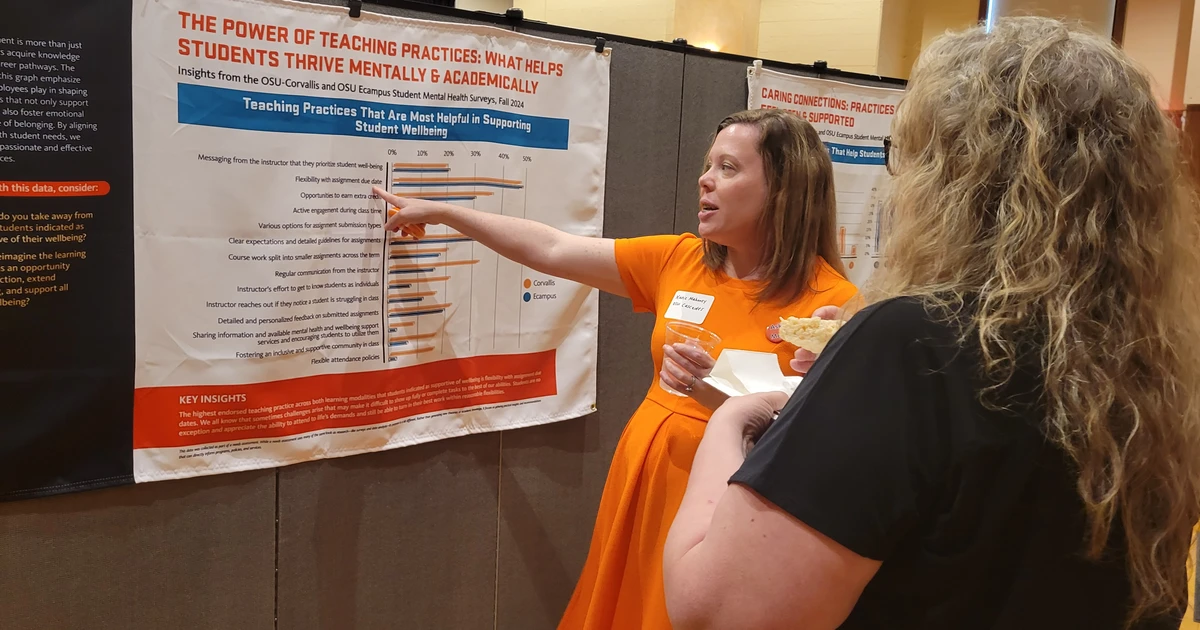
After the ceremony in the Memorial Union Ballroom, university officials and employees participated in a data walk, a curated and interactive opportunity for participants to access key data about OSU mental health in a visual and accessible format. Participants were able to pause and absorb information, reflect on insights and explore how the information relates to the work they do on campus or in the community.
Source link ← Back to News