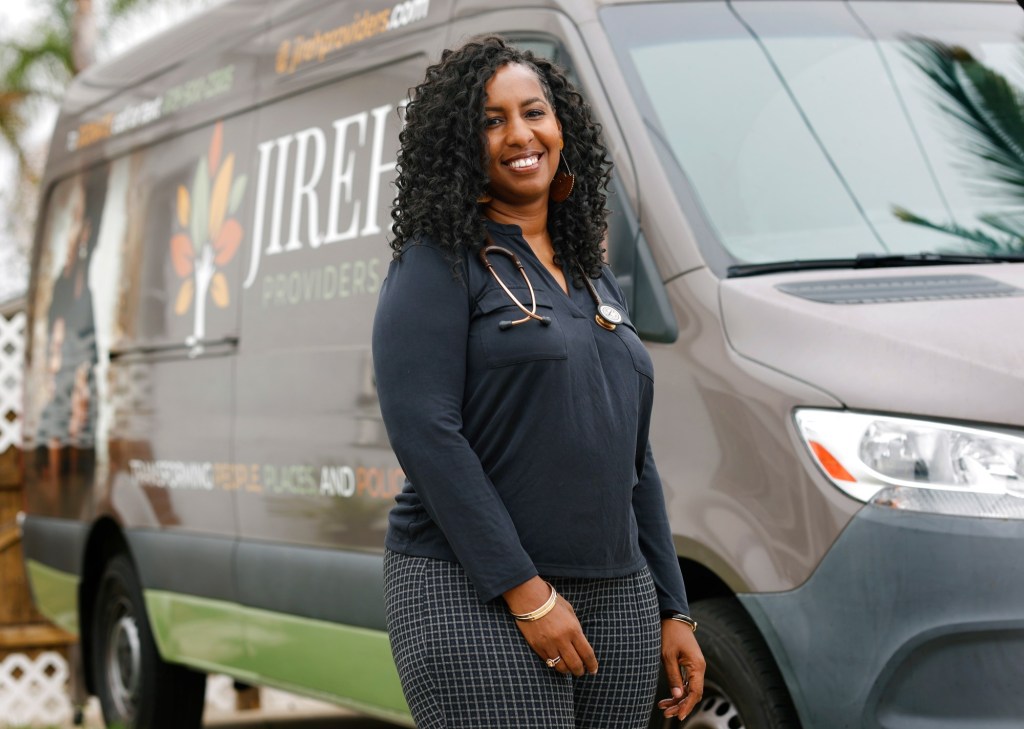
Samantha Williams saw early on what health care felt like and how it was functioning, and what it had the potential to be for folks who looked like her.
“My interest in health care started at a very young age. While I always knew I had a very nurturing and caring side to me, I was officially introduced to it as a teenager while attending an all-girls school in Chicago, Ill. Over time, as my understanding of the disparities in health care among communities of color grew, I realized that improving health outcomes required more than treating symptoms; it required addressing the systemic inequities, mistrust, and barriers that prevent people from receiving compassionate, equitable care in the first place,” she says. “I also experienced my own deep, personal, moral injury when giving birth at the age of 16. I felt unheard, unprotected, not fully cared for. That experience, among others, has always stayed with me. I realized health care is not just about medicine, it’s also about trust, dignity, communication, advocacy, and whether people feel safe enough to seek care in the first place. That realization shaped the type of provider I wanted to become.”
She became a family nurse practitioner, earning bachelor’s and master’s degrees in nursing, with more than 25 years working to address the needs of communities who’ve been historically excluded and underserved by traditional health care. Part of that work has included co-founding JIREH Providers, a nonprofit mobile community health clinic focused on providing support and services to people in southeastern San Diego. As a result, she’s been repeatedly recognized with awards from a number of organizations, including her latest recognition — as one of the recipients of the 2026 Nancy Jamison Fund for Social Justice Award. Jamison was president and CEO of Catalyst of San Diego and Imperial Counties (formerly known as San Diego Grantmakers), a collective of organizations, businesses, and individuals connected with groups and programs focused on social change; she died in 2021. Williams, along with fellow recipient Genevieve Jones-Wright, founder and executive director of Community Advocates for Just and Moral Governance, will each receive an unrestricted $50,000 grant to advance their work.
Williams, 44, also served as chair of the COVID-19 task force for the San Diego Black Nurses Association during the beginning of the pandemic, and also coordinated care and support during the 2024 flooding that hit southeastern San Diego. She lives in City Heights with her husband, Detlef Andreas Williams, and they have three children.
Q: Congratulations on your Nancy Jamison Fund for Social Justice Award for your work “advancing racial equity and social justice in San Diego County.” What does it mean to you to be recognized in this way?
A: This recognition means a great deal to me, not only because of the work it acknowledges, but because of who Nancy Jamison was and what she stood for. Nancy understood that systems, especially within philanthropy and healthcare, can unintentionally perpetuate inequities, and she was courageous enough to challenge those systems with authenticity, humility, and a genuine commitment to justice. To receive an award created in her honor is incredibly meaningful because so much of JIREH’s work is centered around the same values: equity, dignity, trust, community partnership, and reimagining systems so they truly serve people who have historically been overlooked. The recognition also means a great deal to me because the work we do is so deeply personal and rooted in community. So much of the work happens quietly — in neighborhoods, parking lots, schools, churches, apartment complexes, and community spaces where people are simply trying to survive and navigate systems that were not built with them in mind. So, to be recognized for advancing racial equity and social justice feels less like a personal achievement and more like recognition of an entire movement of people who have been advocating, organizing, healing, and showing up for one another for years. It also affirms that community-rooted models of care matter and deserve investment.
What I love about City Heights…
What I love most is the sense of resilience and culture within the community. Southeastern San Diego is incredibly rich in history, diversity, creativity, and strength. There’s a deep sense of connection and care among people here. Despite the challenges the community has faced, there is still so much beauty, brilliance, and hope here and that continues to inspire me every day.
Q: In 2021, you co-founded JIREH Providers. Can you talk about the purpose of your organization?
A: JIREH was created to bring care directly into communities in ways that feel accessible, culturally responsive, and rooted in dignity. The genesis of our work began during the (COVID-19) pandemic, where the need was understood but there was a disconnect in bringing us together to do it. For the first time in my career, I began the deep work of “finding us.” After we found us, we were able to find others who were allies to the work and deeply needed to execute the mission.
We focus heavily on communities in southeastern San Diego that have historically experienced significant barriers to health care access and trust. Our work includes health education, screenings, testing and treatment programs, care coordination, maternal health initiatives, disaster response, community health worker programs, and wraparound support services. We really try to meet people where they are physically, emotionally, culturally, and socially.
Q: Why was JIREH Providers something you wanted to do?
A: To be very honest, I was tired of seeing large amounts of funding continuously flow into the same traditional institutions while communities continued experiencing the same outcomes. It really got under my skin seeing impact reports normalize statements like, “We were unable to complete the deliverable because the population was too hard to reach.” From my perspective, the issue was never that communities were “too hard to reach.” The issue was that systems were often not designed to genuinely engage people in ways that were accessible, trusted, culturally responsive, and rooted in relationships. I knew there were real solutions and approaches to the work that weren’t being lifted up. One of my favorite articles to this day is by the Robert Wood Johnson Foundation, “Self-Healing Communities: A Transformational Process Model for Improving Intergenerational Health.” JIREH was created to challenge that mindset. We wanted to build something community-rooted, something willing to go directly into neighborhoods, meet people where they are (not just geographically, but in every way), build trust over time, and recognize that communities already hold incredible wisdom, resilience, and solutions within them. I wanted to create something that addressed the gaps I was seeing every day in traditional health care settings. I saw too many people falling through the cracks — not because they didn’t care about their health, but because the system often felt inaccessible, rushed, judgmental, or disconnected from their realities. I also wanted to build a model that valued community wisdom just as much as clinical expertise. Some of the most powerful healing happens in trusted community spaces, and I wanted health care to feel more human again.
Q: Can you walk us through how your organization works?
A: Most people connect with JIREH through community events, outreach efforts, referrals, schools, word of mouth, or partnerships with other organizations. Once someone connects with us, we assess what their needs are and help connect them to appropriate services and support. Sometimes that looks like helping someone navigate healthcare appointments; other times it may involve connecting them to food resources, mental health support, maternal health programs, disaster recovery assistance, transportation support, or community health workers who can continue walking alongside them. We try to reduce barriers and simplify systems that can often feel overwhelming. Much of our work is still evolving in many ways because we are constantly responding to what the community is showing us in real time. Initially, we believed many of our programs would primarily center around supporting the county’s “3-4-50” approach, which focuses on the idea that a small percentage of the population experiences the highest level of complex health and social needs, often driven by chronic conditions, behavioral health challenges, housing instability, and systemic inequities. While that absolutely remains part of our work, we also began recognizing something bigger over time — we had organically become a major community response organization.
Q: Your website talks about the lack of equitable health care in communities of color in southeastern San Diego. What are some of the barriers to health care you’ve seen for folks in southeastern San Diego?
A: The most prominent barriers include lack of transportation, underinsurance or lack of insurance, language barriers, limited clinic availability, provider shortages, financial hardship, digital access issues, and historical mistrust of healthcare systems. There are also deeper systemic issues tied to poverty, environmental inequities, racism, housing instability, and disinvestment in certain neighborhoods over generations. Many families are juggling survival needs long before preventive health care becomes a priority.
Q: In your experience, what makes Black and Latino people reluctant to seek out health care services?
A: For many people, reluctance is rooted in lived experiences, not ignorance. Many individuals have experienced discrimination, dismissal, lack of representation, rushed care, or situations where they felt unheard or disrespected. There are also practical barriers like cost, transportation, fear around immigration issues, inability to take time off work, childcare responsibilities, and previous negative experiences with systems overall. Trust has to be earned.
I had a major “aha” moment myself during the pandemic when I went down to Petco Park while thousands of vaccines were being administered each day. I remember looking across a sea of people and realizing I couldn’t find one person that looked like me. Even as an educated health care provider, I felt a sense of hesitation and discomfort that surprised me. I found myself asking, “If I have an adverse reaction to this vaccine, who will care for me? Who will recognize or truly value my life?” That moment reminded of the justifiable distrust communities of color have with the systems that were “on paper” built to serve them. It reminded me of the layered conversation regarding the emotional and historical layers behind medical mistrust in communities of color. For many Black and Latino individuals, reluctance around health care is not rooted in ignorance or a lack of concern about health; it is often rooted in lived experiences, historical harm, systemic racism, underrepresentation, dismissal, and generations of navigating systems where people did not always feel protected, heard, or prioritized. When you combine that with barriers like cost, transportation, immigration fears, language barriers, and economic stress, health care can begin to feel emotionally unsafe rather than supportive. That experience helped to reframe the way I think about health care access. It reminded me that trust cannot simply be demanded from communities, it has to be earned through consistency, representation, compassion, and genuine relationship-building.
Q: Can you talk about the traditional setting for receiving health care, versus the community space for it?
A: Traditional health care settings are often designed around efficiency, productivity, and systems. Community spaces are designed around relationships, trust, accessibility, and human connection. In traditional settings, people often feel rushed, intimidated, and unseen. In community spaces, people are often more relaxed and open because they are in environments that feel familiar and culturally affirming. That changes the entire interaction and creates opportunities for deeper engagement, prevention-focused care, and a greater likelihood of adherence to prescribed modalities of treatment.
Q: How would you define culturally responsive care?
A: Culturally responsive care means understanding that people’s backgrounds, identities, histories, traditions, and lived experiences impact how they experience healthcare. It requires providers to listen without assumptions, communicate respectfully, and adapt care in ways that honor the individual and community. It also means representation matters. Patients should be able to see themselves reflected in health care spaces and feel safe bringing their full selves into those environments.
Q: Your website also mentions that JIREH has two meanings for your organization-Joint Initiatives for Racial Equity in Health, and “God is my provider.” How has your faith informed your work?
A: My faith has grounded me through some of the hardest moments of this journey. It’s the best part of me, it’s the best part of my life. This work can be so emotionally heavy and taxing, and there are many moments where the needs are definitely greater than the resources available. Faith reminds me to continue serving with compassion, humility, and perseverance. The name JIREH reflects both our mission around racial equity in health and the belief that through faith, provision, healing, and purpose can exist even during uncertainty.
Q: What is the best advice you’ve ever received?
A: “You don’t have to do everything at once to make a difference.” That reminder has helped me stay focused on progress instead of perfection.
Q: What is one thing people would be surprised to find out about you?
A: People are often surprised to learn how introverted I actually am. Even though I spend a lot of time speaking publicly and leading community initiatives, I recharge through quiet moments with family and reflection.
Q: Please describe your ideal San Diego weekend.
A: My ideal San Diego weekend would include spending time with family, a 5,000-piece puzzle, good food, good music, rest, and being near the water. I love the water, but I hate crowds. I love moments that feel simple and grounding, whether that’s attending a community event, supporting local businesses, or just enjoying the beauty and diversity of San Diego.
To suggest a notable San Diegan for the One-on-One series, contact Lisa Deaderick at [email protected].
Source link ← Back to News