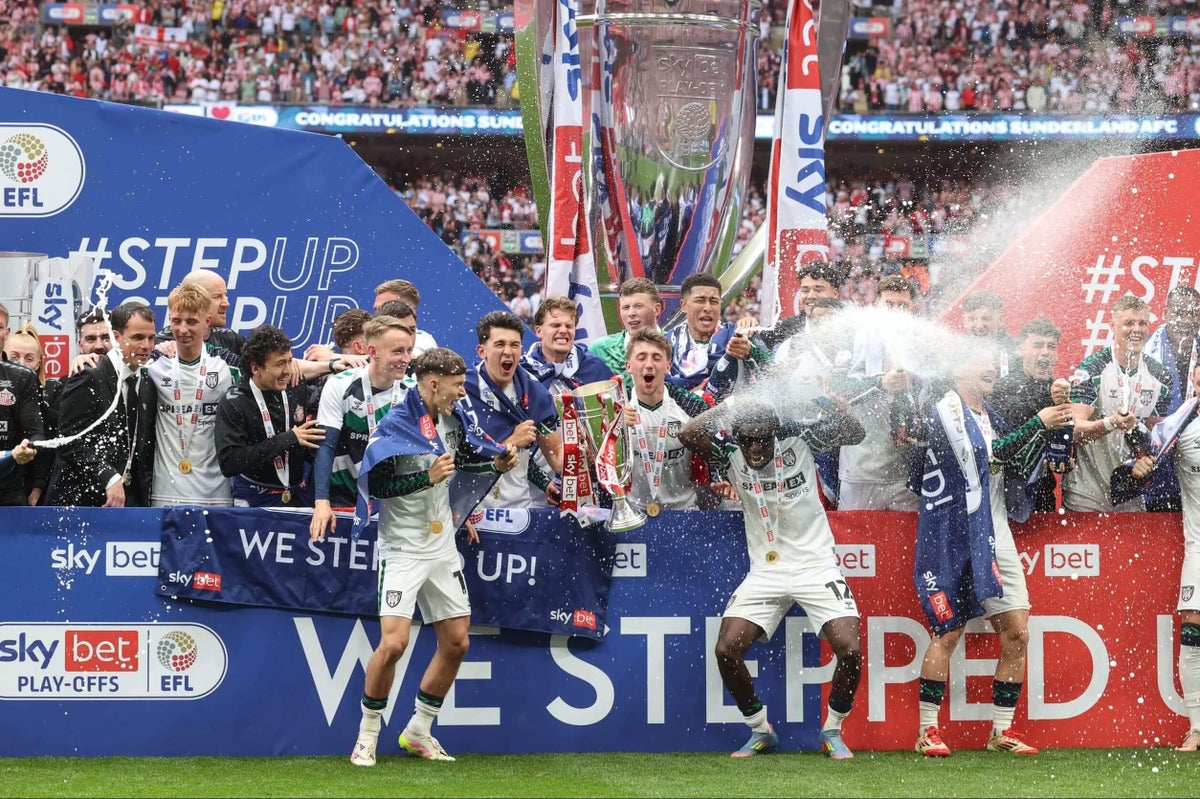
The play-offs. A concept, when introduced four decades ago by the Football League, that proved so divisive one victorious manager called for them to be scrapped just minutes after winning the final.
Happily, from such inauspicious beginnings, the end-of-season promotion deciders have evolved into a cherished, if rather anxiety-inducing, climax to the domestic season.
A grand total of 105 different teams have competed in the play-offs, each one experiencing the unique emotions of a format that can take players, supporters and managers from the highest of the highs to a truly gut-punching low, often in the space of just a few minutes.
Blackpool boast the highest tally of promotions via this route with six, while Sheffield United fans must dread qualification after 10 unsuccessful attempts to go up, a record.
Fifteen finals have been decided on penalties, including a hat-trick of successes for Huddersfield Town. As if to underline the incredibly thin dividing line between success and failure in these EFL showpieces, the Yorkshire club failed to score during normal time in all three of those finals before going on to triumph from the spot.

Huddersfield have been promoted after a play-off final shootout three times (Glyn Kirk/Getty Images)
The list of heroes forged by the play-offs grows longer every year, with Dean Windass, Sasa Ilic, Paul Dickov, David Hopkin and Troy Deeney just some of those to have carved their place in folklore.
Will anyone join that pantheon of promotion greats over the next few days? Or will 2026 be better known for events away from the pitch, as the Spygate row that this week saw Southampton sensationally kicked out of the Championship final — aka, the richest game in football, with £200million at stake — rumbles on?
To whet the appetite for a weekend that has become a football institution, The Athletic picks out a few highlights from the past 40 years.
The landscape of English football in the mid-1980s was very different to today. Not only were hooligans running riot every week, but the grounds weren’t fit for purpose, and attendances were locked into a sustained nosedive.
Into this maelstrom of misery stepped the play-offs, initially conceived as a way of bringing added spice to the final few weeks of the season in Divisions Three and Four but then also quickly adopted by the second tier as the fairest means of reducing the top flight from 22 to 20 clubs.
The drama began straight away in a format that pitted the fourth-bottom team from the top flight against the sides who finished third, fourth and fifth in the division below.
Leeds United looked to be heading out in the semi-finals when Mike Cecere put Oldham Athletic 2-1 ahead on aggregate with just 90 seconds of the second leg remaining. Keith Edwards, however, had other ideas, the substitute following his 90th-minute goal in the Elland Road tie by again finding the net in stoppage time.
Having negotiated 30 minutes of extra time on the Boundary Park plastic pitch to progress on away goals, Leeds met Charlton Athletic in a two-legged final, the concept of a one-off decider at Wembley not arriving until 1990.
Neither team could be separated over two nerve-shredding ties, meaning they had to meet again in a replay on neutral turf at St Andrew’s, Birmingham.
“It was another tight game,” recalls Ian Baird, Leeds’ 15-goal top scorer in the league that season. “Nil-nil after 90 minutes, but then Shez (John Sheridan) put us ahead with a fantastic free kick in extra time.
“We were seven minutes away from going up when our nemesis arrived.”
Peter Shirtliff had joined Charlton the previous summer with a hard-earned reputation for stopping, rather than scoring, goals.

The name Peter Shirtliff will haunt a generation of Leeds United fans (Mirrorpix/Getty Images)
However, having netted just four times in 188 league appearances for previous club Sheffield Wednesday, the 26-year-old defender broke Leeds hearts by scoring twice inside four minutes to keep Charlton up.
“We’d lost the FA Cup semi-final to Coventry a few weeks earlier,” adds Baird. “But this felt far worse. Leeds had been through plenty of ups and downs since the great Revie team, and this was a massive opportunity for the club.”
As for the play-offs, he adds: “This was the first year, so a new experience for everyone. I remember at one stage against Oldham in the second leg having to ask the referee what the aggregate score was. Things had got so crazy.
“Fans really bought into it, too. Before the home match against Charlton, Billy (Bremner, Leeds manager) took us to the Holiday Inn in North Leeds. A journey to Elland Road that should have taken 20 minutes took us more than an hour.
“All the gates were locked way before kick-off, with some even watching from up on Beeston Hill.”
The play-offs’ propensity for drama had been established from the off. Not everyone, mind, was a fan. Joe Royle, whose Oldham side had finished seven points above semi-final conquerors Leeds, bemoaned how the League had just become “the longest Cup competition in the world” after playing 44 games only to go out on away goals.
Lou Macari, manager of Swindon Town, went even further, calling for the format to be scrapped entirely following his side’s victory over Gillingham in the Third Division final. “I never want to go through a game like this again,” said the Scot after Swindon’s 2-0 win in a replay staged at Selhurst Park.
Thankfully, the League had other ideas. A switch to four teams from the same division taking part followed in 1989 and then a one-off final 12 months later, Cambridge United (Division Four), Notts County (Division Three) and Swindon Town (Division Two) the first three teams to experience the joy of a Wembley promotion.
Swindon’s celebrations, however, didn’t last. Just 10 days later, the club admitted 36 breaches of League rules (mostly concerning illegal payments to players) and were relegated two divisions, a punishment later reduced on appeal to one. Sunderland, beaten 1-0 by Ossie Ardiles’ side in the final, went up instead.
Proof that off-field matters casting a shadow over the play-offs is far from a recent development.
Dean Windass doesn’t need a memento of the day he fired hometown club Hull City into the Premier League for the first time in true ‘Roy of the Rovers’ fashion.
“I can’t describe the feeling,” says the former striker about his volleyed winner against Bristol City in the 2008 Championship play-offs final. “Moments like that just don’t happen to an ordinary lad from Hull.

Dean Windass provided one of the great play-off final moments in 2008 (Clive Rose/Getty Images)
“Bristol City probably had the better of what wasn’t a great game. You often find that with finals, especially in the Championship, where the biggest financial prize in football is at stake. No one wants to make a mistake.
“Luckily for me, when the chance came my way, I caught it just right. You attempt shots like that all the time in training, and they can fly anywhere. But not this day.”
History would repeat itself 15 years later when Windass’ son Josh netted Sheffield Wednesday’s winner in the 2023 League One play-offs final.
“I see that goal as a different part of my life,” adds Windass senior. “It’s why I don’t have anything left from the day. My shirt, medal and even a big photo with ‘The £60 million Man’ written on it — as that’s what promotion was worth to clubs back then — have all been auctioned off for a cancer charity.
“I don’t need memorabilia to remind me what a special day Wembley was.”
For every elated winner in the play-offs, there has to be a loser. Those contrasting emotions are what make, say, Hopkin’s last-minute winner for Crystal Palace in 1997 against Sheffield United so memorable.
Likewise, Deeney’s last-gasp winner for Watford against Leicester City 16 years later, when the striker’s unconfined joy at firing his team to Wembley was in stark contrast to the despair felt by Anthony Knockaert over his saved penalty seconds earlier.
Brett Ormerod knows a thing or two about the ups and downs of the play-offs. Twice, he scored in finals to help Blackpool to promotion, those 2001 and 2010 successes book-ending a horrific leg-break suffered when exiting the 2006 Championship semi-finals in Preston North End colours.
“The best day of my life,” is how the former striker describes the second of those promotions with Blackpool, a 3-2 victory over Cardiff City. “I remember not even looking at the Cardiff players when we were shaking hands before the game.
“This was my chance to be back in the Premier League and these people were standing in my way.”

Brett Ormerod scoring for Blackpool against Cardiff – “the best day of my life” (John Walton/Getty Images)
Remarkably, all five goals were scored in the first half, Ormerod netting from close range what proved to be the decisive strike in stoppage time.
“We trained at Bisham Abbey the day before the final,” he adds. “Charlie Adam was practising these free kicks, pinging them in. One landed right in the stanchion so I said to him, ‘Oi, d***head, get inside and save that for tomorrow’.
“Anyway, what does he do at Wembley? Only curls in one of the best free kicks I’ve seen.”
Adam’s free kick cancelled out Michael Chopra’s opener only for Joe Ledley to restore Cardiff’s lead. Gary Taylor Fletcher then netted a second equaliser before Ormerod’s close-range finish settled matters.
“The only time I got nervous in that game was when I came off,” he adds. “Cardiff nearly scored late on but by then I’d gone to the dressing room, I just couldn’t watch. I had (team-mate) Billy Clarke running back and forth, telling me how things were going, as I paced up and down.”
Ormerod’s joy at scoring in two finals — the first in 2001 saw Blackpool beat Leyton Orient 4-2 to win promotion from the fourth tier — was in stark contrast to the broken leg suffered for Preston against Leeds in 2006.
Having drawn 1-1 at Elland Road in the first leg, Preston were strongly fancied to progress to the Championship final. Ormerod’s involvement in the return, however, lasted just 10 minutes, the striker stretchered off after a tackle by Jonathan Douglas.
“I was taken to Preston Royal (Hospital), where an X-ray revealed the bone had been snapped in six places,” says Ormerod. “Straight after the doctor tells me they’d need to schedule an operation, this nurse walks in and says, ‘Leeds have scored’.
“Two minutes later, she’s back to say it’s 2-0. That was a low point in my career.”
As Noel and Liam Gallagher partied hard at Wembley in 1999 after Manchester City had escaped the third tier of English football via a comeback even more spectacular than that pulled off by Oasis last year, Carl Asaba felt bereft.
Having put Gillingham ahead on 81 minutes and then been substituted in the wake of Robert Taylor making it 2-0, the club’s top scorer could only watch in horror as, first, Kevin Horlock pulled a goal back for City on 90 minutes and then Dickov struck five minutes into stoppage time to level the scores.
City subsequently triumphed on penalties to kick-start a revival that, just 13 years later, would see the blue half of Manchester claim the first of eight Premier League titles.

Carl Asaba’s opening goal in the 1999 Division Two final was forgotten thanks to Manchester City’s comeback (Tony Harris/Getty Images)
“It was the greatest feeling ever as I came off,” says Asaba, who missed the next nine months after being nursed through multiple injuries during the run-in. “You’re at Wembley, 80,000 people are there, you’ve set up one goal, scored another and you’re 2-0 up against Manchester City in the 88th minute.
“But then everything just unravelled. No one’s fault, the boys gave it their all. But, still, a real watershed moment in my life, in that I learned you can give absolutely everything but still end up as a loser.”
Asaba and his Gillingham team-mates did have the consolation of returning to Wembley a year later to clinch promotion. Again, it came amid high drama as two goals in the final six minutes of extra time were required to see off Wigan Athletic 3-2.
“Winning the following year was a huge release,” says Asaba, who also tasted defeat in play-off finals with Brentford (1997) and Sheffield United (2003). “It wasn’t necessarily a case of celebrating the victory.
“More that I wasn’t experiencing the heartbreaking pain of the previous year. Nothing compares in football to the pain of losing a play-off final. Nothing.”
Psychology can play a big part in the play-offs, as Chris Kamara proved 30 years ago when taking his Bradford City side to Wembley against all the odds.
Trailing 2-0 to Sam Allardyce’s Blackpool from the home leg, Bradford travelled to the seaside badly in need of a lift. Kamara found it a couple of hours before kick-off when flicking through a copy of the matchday programme.
Not only did he consider the tone to be bordering on triumphalism following Blackpool’s victory at Valley Parade three days earlier. But the home club had also printed maps of how to get to Wembley, plus details of coach travel to the final.
Kamara quickly snapped up as many copies as the seller outside Bloomfield Road had and then plastered the offending pages all over the away dressing room walls. Suitably incensed, Bradford ran out 3-0 winners on the night.

Chris Kamara (right) put on a motivational masterclass with Bradford in 1996 (Aubrey Washington/Getty Images)
The future Sky Sports presenter wasn’t finished there, either. Knowing the Yorkshire club’s 32,000-strong support at Wembley would massively outnumber the 8,000 fans backing Notts County, Kamara arranged for his team to arrive at the stadium after their opponents.
This meant the Notts players couldn’t fail to hear the huge roar that would inevitably greet the Bradford team when walking out of the tunnel for the first time.
“Kammy was great like that,” recalls Eddie Youds, captain that day as City won 2-0 under the Twin Towers. “He knew how to press the right buttons. Mind, not everything went to plan.
“The day before the first leg against Blackpool, Kammy brought this motivational speaker in. He was brilliant. Telling us about how he’d worked with all these greats, world snooker champions the lot.
“By the end, we’re all jumping up and down, saying we’re going to win. The following day, I’m certain Blackpool wouldn’t even score, never mind beat us. Next thing I know we’re 2-0 down and Kammy is going off his head!”
Youds, by now playing for Charlton Athletic, was back at Wembley two years later for surely the greatest play-offs final of all-time against Sunderland.
Across a pulsating 120 minutes, the two teams shared eight goals in an afternoon of drama containing the additional plotline of lifelong Sunderland fan Clive Mendonca netting a hat-trick for the Londoners.

Charlton celebrate winning an all-time classic final against Sunderland in 1998 (Shaun Botterill/Allsport)
With the tension by now unbearable, the final went to penalties. The first 13 spot kicks were successful, meaning Sunderland’s Michael Gray had to score. He failed, goalkeeper Ilic saving a weak penalty low to his left.
“Sasa got a load of plaudits afterwards,” laughs Youds. “But my nan could have saved that! We had a bus tour a couple of days after the final. I remember Sasa on the top deck with the mic, saying how he’d done it all ‘for my fans’. I’m laughing my head off. We’d conceded four goals!”
Youds did, though, have one huge reason to be grateful to the former Yugoslavia international.
“I was down to take the next penalty,” says the Liverpudlian, now working as an estate agent in south London. “I was s***ing myself. Steve Jones, our centre-forward, had taken his boots off and said he couldn’t take one.
“Richard Rufus had also walked to the other end of Wembley. So, I said I’d take one. It was a horrible feeling watching each penalty go in, knowing my turn was edging closer.
“We were on a really good bonus to win promotion but I’d have given up every single penny not to have to take that penalty. I can’t tell you the relief when it was saved.”
Source link ← Back to News