Immigration crackdown costs billions in lost taxes, a bipartisan geothermal energy coalition emerges, and more.
This is your first of three free stories this month. Become a free or sustaining member to read unlimited articles, webinars and ebooks.
Welcome back to The Weekly Wrap, our Friday roundup of stories that explain the problems oppressing people in cities and elevate the solutions that bring us closer to economic, environmental, and social justice. If you enjoy this newsletter, share it with a friend or colleague and tell them to subscribe.
Hawaiʻi Curbs Corporate Influence in Elections
Hawaiʻi Gov. Josh Green has signed a first-of-its-kind law that bars corporations doing business in the state from engaging in state, local, or federal elections, The American Prospect reports.
The law, SB2471, will go into effect in July 2027 and bars corporations from donating directly to politicians or Super PACs or funding ballot initiatives. Violating the law could result in a loss of legal status. Similar bills have been proposed in 14 other states, according to the Prospect.
The legal theory behind the law posits that corporations only exist according to the charters of the states they operate within. (“The creation and continued existence of a corporation is not a right but a conditional grant of legal status by the State and remains subject to complete withdrawal at any time,” the law states.).
Trump Immigration Crackdown Will Leave Half-Trillion Dollar Hole
The Trump administration’s immigration crackdown could lead to almost half a trillion dollars in lost tax revenue over the course of a decade, The Guardian reports.
This is largely a result of a data-sharing agreement between the IRS and the Department of Homeland Security, which has made undocumented immigrants fearful of filing their taxes. The data-sharing agreement reached in April 2025 was shut down by a federal judge last February, but not before the IRS shared thousands of addresses with DHS.
“Immigrants who are not legally authorized to work in the US are still required to pay taxes, and a longstanding IRS policy assured them that their data would be protected,” The Guardian explains. According to the Institute on Tax and Economic Policy, undocumented immigrants paid close to $100 billion in taxes in 2022. That includes $25.7 billion for Social Security, $6.4 billion for Medicare and $1.8 billion for unemployment insurance — none of which they may access.
Rail Workers Reach Deal with MTA After Three-Day Strike
A Long Island Rail Road strike that lasted three days and impacted 270,000 commuters ended on Tuesday, Gothamist reports. The MTA reached a deal with the five unions representing 3500 LIRR workers that will include wage increases, The City reports, although the parties declined to provide specifics until the deal was finalized.
The National Mediation Board had to intervene on Sunday night when parties couldn’t come to an agreement to end what was the first LIRR strike since 1994. The MTA is currently negotiating a contract for subway conductors, but unlike LIRR workers, they’re not permitted to organize work stoppages.
Southwestern States Join Forces To Boost Geothermal Energy
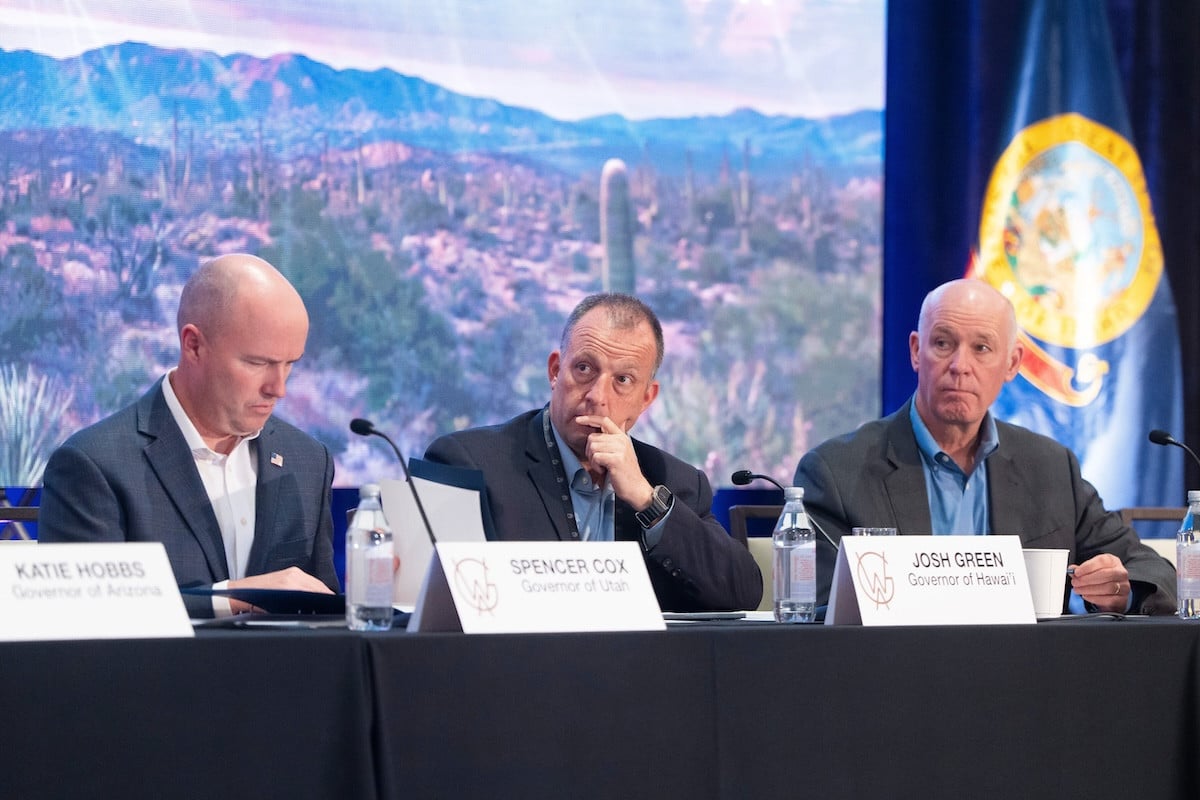
A new, bipartisan coalition of governors from the Mountain West have launched an initiative that would generate an estimated 200 gigawatts of clean energy, Canary Media reports, increasing America’s ability to produce geothermal electricity by a full 50 times.
Through the Center for Public Enterprise’s new Mountain West Geothermal Consortium, officials from Arizona, Colorado, New Mexico, and Utah will work together to help overcome the financing risks and permitting challenges that have made scaling geothermal difficult.
“The idea that we can unleash clean, affordable, dispatchable power … that’s kind of the Holy Grail, what we’ve all been chasing. And yet it’s a reality now in ways that it’s never been before,” Utah’s Republican Gov. Spencer Cox said. “If it’s just one state going it alone, that’s great, but you don’t get the attention, the capital, the investment that you need.”
Spanberger Makes Sick Leave Universal in Virginia
Gov. Abigail Spanberger of Virginia has signed paid sick leave legislation that covers more than a million workers who do not have access through their employers, according to a press release.
The law, which requires companies to allot at least one hour of sick leave per 30 days worked for up to at least 5 days a year, takes effect July 2027, WTVR reports. Companies who already provide the minimum allotment of sick leave will not be required to change their policies. The governor’s office said a lack of sick leave is mostly felt by low-wage workers, including those in the fast food and personal care industries.
MORE NEWS
-
Portland’s billion-dollar climate fund becomes a blueprint for other cities. OPB
-
LA County to end ban on rent gouging, 16 months after fires created rental market chaos. LAist
-
Gas prices are rising. So is public transit ridership. Grist
-
The unhappy hosts of the World Cup. The Atlantic
-
Report: New Yorkers deserve Rent Emergency Stabilization for Tenants Act. Community Service Society
-
House overwhelmingly passes amended ROAD to Housing bill. Multifamily Dive
-
Trump officials plan to repeal limits on ‘forever chemicals’ in drinking water. The Guardian
-
In conservative Utah, some communities are ditching fossil fuel power for clean energy. NPR
-
‘Stop killing us’: New York’s home care providers near hunger strike over wage injustice. The Guardian
-
AvalonBay and Equity Residential announce ‘merger of equals.’ Multifamily Dive
OPPORTUNITIES & RESOURCES
-
DUE TODAY: The Sparkplug Foundation is offering grants to support early-stage programs that focus on music programs, community organizing, and education. Apply by May 22.
-
New Profit is launching Connected Futures, a Catalyze cohort for organizations that bridge divides and bring people together to solve problems collectively. Selected organizations will receive a one-year $100,000 unrestricted grant, a $10,000 grant for leadership development, and strategic advisory support. Submit a discovery form by May 26.
-
Kelly Jin is open to expressions of interest for her $25,000 Catalyst Fund for nonprofits and projects building civic infrastructure and community connectedness. Read more and fill out the interest form by May 27.
-
Hispanics in Philanthropy’s Líderes Fellowship is accepting applications from mid-career Latine, Afrolatines, and Native leaders working in philanthropy and nonprofits in the American Southwest. Apply by May 31.
-
Arbor Rising is seeking to support nonprofits building pathways out of poverty, particularly in education and job training. Grantees will receive $125,000 in unrestricted funds plus capacity-building consulting. Submit a letter of interest by June 9.
-
The Decolonizing Wealth Project is accepting applications for its Indigenous Earth Fund, which supports advocacy campaigns and movement-building efforts that center Indigenous solutions to the climate crisis. Apply by June 11.
-
Envision Resilience is opening applications for its National Design Studio Grant for schools running design studios focused on community-centered approaches to climate challenges. Apply by June 19.

Roshan Abraham is a contributing editor for housing and homelessness at Next City. Based in Queens, New York, he has written extensively about city policy, including prisons and policing, housing and homelessness for The Guardian, The New York Times, Slate, The Baffler, Village Voice, The Verge, Pacific Standard, The Appeal, Vice and other outlets. At Vice, he was formerly a staff writer covering the housing beat. He is a former Open City Fellow and Witness Fellow at the Asian American Writers Workshop and a former Equitable Cities Fellow at Next City.