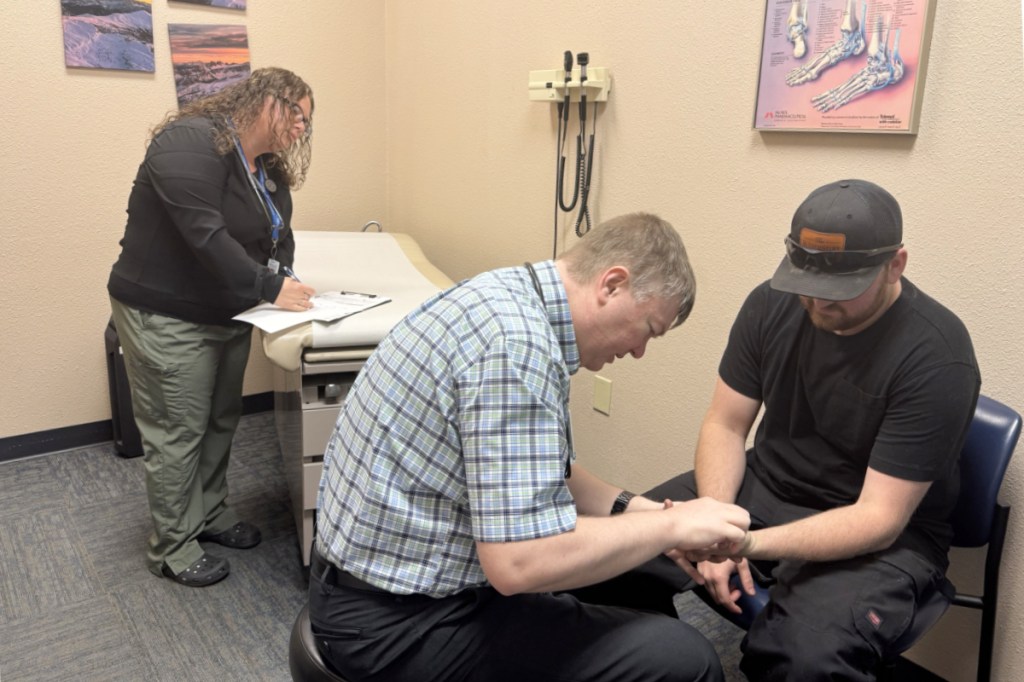
Through occupational health and injured worker care, Valley Immediate Care helps keep southern Oregon on the job
When someone is injured on the job, the last thing they – or their employers – want is a long road back to work.
Beyond the physical impacts, a protracted absence can also bring financial stressors and challenges for relationships and mental health.
“It’s so important for people to get back to work in a timely but safe manner,” says Valley Immediate Care CEO Brent Kell. “A workplace injury not only affects their livelihood, it affects their family, and their psychological well-being.”
For Valley Immediate Care, where a little less than 30 percent of this year’s 88,000 patient visits will involve employment services or injured workers, a successful Occupational Health and Injured Worker program is built on partnerships – between the employer, employees and a medical team that includes Dr. Maria Miller, Nurse Practitioner Brent Kordenbrock and Physician Assistant Rob Hoffner.
It also provides seven-day-a-week access to care – essential for those who work weekends – and injured worker care in North Medford, South Medford, Eagle Point, Ashland, Grants Pass and Central Point.
“We approach occupational health as partners with the approximately 1,500 employers that we work with, all the way from single owner-operator truckers, to large manufacturers, municipalities and county operations,” Kell says.
What is the difference between occupational health and injured worker care?
Think of occupational health and injured worker care as two sides of the same coin, Kell explains.
Occupational health services, which Valley Immediate Care provides to many Rogue Valley companies, include things like employee or Department of Transportation physicals, hearing exams, pulmonary function tests, respirator fit testing – initiatives to support and gauge employee wellness.
Then, if an employee becomes ill or injured on the job, the team works with the worker and employer to get them back to work as soon and as safely as possible.
“Research suggests that after four weeks being off because of a work injury, the likelihood of going back to the same job is less than 50 percent.”
Strong protocols within both programs benefit employers and employees.
“Certainly for the employer, it’s costly when you have people off work because of injury. But getting back to work sooner is better for the employee as well. Research suggests that after four weeks being off because of a work injury, the likelihood of going back to the same job is less than 50 percent,” Kell says.
A well-designed treatment and return-to-work plan is essential to overcome or mitigate physical limitations but also to avoid mindset changes that a prolonged injury can bring: “At some point, some people are less likely to go back to any kind of work – they begin to identify with their injury rather than their job. They’re not a bricklayer anymore, they’re an injured worker, and they change their mindset to match that.”
Other times, employees may want to return to their job sooner than they should. In both cases, a modified return to work can provide a valuable stepping stone to keep employees engaged and working.
“With most of the injuries we see in urgent care, people can legitimately form perform some kind of light duty – walking around, picking up the phone. And most enlightened employers understand the benefit of having them return, so they’ll create a role for them during recovery,” Kell says.
“Those employers can really change the equation by keeping people coming to work, and everything that entails – getting up in the morning, making breakfast and leaving the house.”
“We’re lucky in Oregon, because the State Accident Insurance Fund team is very proactive with light duty job descriptions and trying to get people back to work. Typically, they have a really good idea, based on thousands of injured workers and patients, how long it takes to get back after a standard knee strain or minor back strain.”
What does a rapid return to work look like in practice?
A return-to-work plan begins with an evaluation with a healthcare provider – at Valley Immediate Care that includes physicians, physician assistants and nurse practitioners, alongside community professionals such as physical therapists or orthopedic surgeons. Tests such as MRIs, CTs or X-rays can provide additional data.
“So, it’s really gathering information from all those different data points, and putting it all together, interviewing the patient, performing objective testing in exams, and then making an educated judgment on what that patient can do at that point in time, and relating that back to their field of employment,” Kell says.”And, that may change over time. It could take months to get back to full duty at the same job, but we try to keep them moving along.”
While the employee is at the center of the plan, it’s also important to keep the employer up to speed, he adds.
“We try to really communicate with employers what’s happening through the process, so they’re not surprised. For larger organizations, that can mean working with their HR departments, while for smaller groups we might work closely with the owner or manager to create a light-duty job description that matches the employee’s ability at that time.
“For the overwhelming majority of patients, when they’re injured, they just want to get back to work.”
To learn more about Valley Immediate Care’s occupational health support for your organization, visit valley-ic.com/occupational-health or call 541-734-9030.
READ MORE: Rogue Valley medical community unites for local health care recruitment