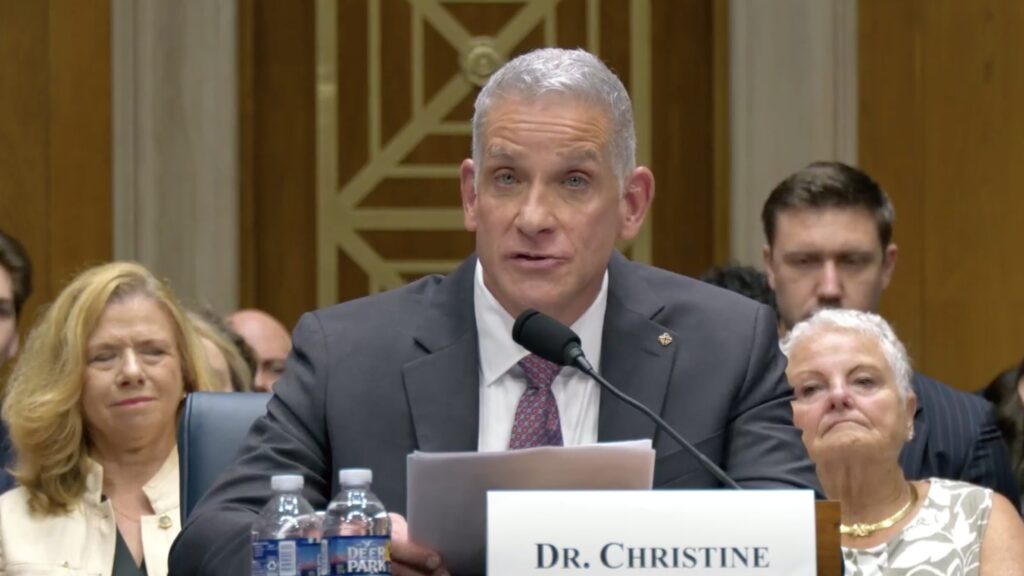
WASHINGTON — Just before he was sworn in as assistant secretary for health at the end of 2025, Admiral Brian Christine — a urologist whose practice treated primarily male patients — talked at an FDA panel on testosterone about a series of alarming statistics: Male life expectancy is close to seven years shorter than women’s; men have higher mortality rates in 10 of the leading causes of death; and they make up the vast majority of deaths by suicide.
“We have a men’s health crisis in this country. Now we need a national strategy,” he said, in a panel on testosterone replacement. He added that establishing a “parallel track” to women’s health for men at the Department of Human and Health Services was a priority of HHS secretary Robert F. Kennedy Jr., and reiterated the message on the day of his swearing in.
His words, and the fact that a urologist was in the assistant secretary role, gave the men’s health community the hope — close to the expectation, in fact — that the agency would soon launch a federal men’s health initiative to mirror the Office of Women’s Health established within the HHS in 1991.
The fact that the State of Men’s Health Act, a bipartisan bill introduced in the House in February by Rep. Troy A. Carter (D-La.) and co-sponsored by Rep. Gregory Murphy (R-N.C.), was slowly signing up co-sponsors from both sides of the aisle, added to the excitement: HHS could start a federal men’s health initiative, or even establish an office of men’s health, while the bill — with the slower timeline for legislative action — would then permanently enact it into law.
But it doesn’t look like that’s going to happen anytime soon.
“I think we’ll probably be at this for at least a couple of sessions and perhaps into a new administration,” said Mark Edney, a practicing urologist in Salisbury, Md., and the chair of the American Urological Association’s (AUA) public policy committee. “There’s no expectation this is going to be done in just a few months, but we’re dedicated to seeing this through, however long it takes.”
The reason is politics. Supporters of an office of men’s health worry that any initiative created by the Trump administration risks being dismantled by a future Democratic president.
Evidence that men’s health is very much in the political zeitgeist can be found in the fact that the State of Men’s Health Act was born without a deliberate effort. Earlier this year, AUA’s patient advocacy manager Melika Zand was chatting with Carter’s senior policy adviser Liz Beltran, who asked her what were the AUA’s priorities at the moment. She responded that an office of men’s health was on everyone’s mind. Beltran “had access to some old bill language, went through it and said that ‘maybe, maybe we can revive this, maybe we can actually create a bill — the environment seems right, maybe we can get this done,’” Edney said.
Partisan concerns with the bill are reflected in its final form, said Edney: Democrats wanted the text to explicitly state that the office wouldn’t take resources away from women’s health, while Republicans opposed attaching any initial price tag to the office, though “they’re fine with the notion of creating it in statute such that it has a future funding mechanism,” he said.
Ironing out partisan differences to agree on bill language is one thing, but ensuring that an office of men’s health doesn’t become a political pawn is a whole other, and insiders are worried a new administration would dismantle the office like Trump’s did with Biden-created offices focused on long Covid, climate change, and health equity.
“The admiral could — can — do this. They can say, ‘All right, we’re just establishing this office’,” Murphy said during a panel at the Sexual Medicine Society of North America’s event during the AUA annual meeting last week in Washington, D.C. “The only problem is administrations change every four years, and now I’ve been in Congress six years and I’ve seen some initiatives that were great all of a sudden disappear with one administration, perhaps reappear with another one,” he said, adding that codifying the office into law would prevent this.
Ian Simon, the former director of the federal Office of Long COVID Research and Practice, said its closing “is a real instructive case of what happens when a new administration comes in and sees an office that they may not support, and they can just close it down with a phone call.”
Long Covid had a level of urgency that required acting fast, he said, but in most cases, “going through Congress … to get it done right so that there’s accountability meeting the needs and the mandate of the office, I think it’s the right way to go.”
Beyond the advantages of setting up the office through legislation — which include a clear path for being funded — the need to do so is an indicator of the increasingly partisan approach to running agencies, Simon said. “In the history of administrations in the last few decades, it was common practice for an agency to set up an office because they felt it was needed and Congress moved slowly, and then work through the slow legislative process to get it authorized,” he said. “It wasn’t seen as anything out of the norm.” But in an increasingly contentious climate, “any office created by one administration would be immediately seen as expendable by the next.”
Adding to the political arguments against establishing an office through HHS, there’s concern that a men’s health office could alienate some voters ahead of the midterms: Even with the explicit guarantee that initiatives on men’s health wouldn’t detract from women’s health resources, the possibility that voters might have such a suspicion is enough to stall action.
“The politics is proving to be a little challenging,” Edney said. “We’ve become aware that even in the current Health and Human Services executive branch, there are conversations about how this is being promulgated largely related to the fact that we’re coming up on midterm elections. … There’s probably some caution on both sides, because nobody wants to really stick their neck out facing what for some are going to be really challenging midterm elections.”
Still, advocates are in for the long haul and see this as their opportunity to get the office established. At the AUA conference, they called the audience to action, encouraging attendees to call their representatives and discuss the bill with their peers. “I have great optimism about this,” said Murphy during the panel. “Don’t be disappointed if this doesn’t pass this year. Most bills take many years and many sessions to happen,” he said, but “the process can work.”
STAT’s coverage of health challenges facing men and boys is supported by Rise Together, a donor advised fund sponsored and administered by National Philanthropic Trust and established by Richard Reeves, founding president of the American Institute for Boys and Men; and by the Boston Foundation. Our financial supporters are not involved in any decisions about our journalism.