On Thursday evenings in Virginia, the lights stay on at Project Care Free Clinic, located in the Arrowhead Center on 12th Avenue West, long after most offices have closed. From 5:30-7:30 p.m., people in need of medical care file in — waitresses, retail workers, the self-employed, neighbors who are uninsured, underinsured or struggling under the weight of rising deductibles. For many, it's the only place they can turn for care.
“They say it takes a village to raise a child,” says Claudia Skalko, the clinic’s site coordinator. “Well, it takes a village to keep people up and running, too.”
That village includes Essentia Health.
Project Care operates three clinics. Essentia providers and other care team members volunteer to staff the one in Virginia, while the clinics in Hibbing and Grand Rapids are supported by Fairview. Each location is open from 5:30-7:30 p.m. one day a week (Hibbing on Mondays, Grand Rapids on Tuesdays and Virginia on Thursdays).
Project Care offers outpatient access and outreach to facilitate treatment, screenings, preventive care and education. Walk-ins and appointments are available.
Healthcare is a calling
Dr. Lisa Seeber, a family medicine physician at the Essentia Health-Virginia Clinic, has volunteered at Project Care for years. She and her colleagues devote much of their time to chronic disease management — for things like hypertension and diabetes — and treating anxiety.
There are a handful of Essentia team members involved in what can best be described as a passion project. They include family medicine physician Dr. Stephen Smith, podiatrist Dr. Robert Sheckler and registered nurse Kelly Nelson. Caring for their community is what they do.
“This is the reason we go into medicine — to care for people,” Dr. Seeber says. “It’s such a privilege to be a physician and to be able to give back like this.”
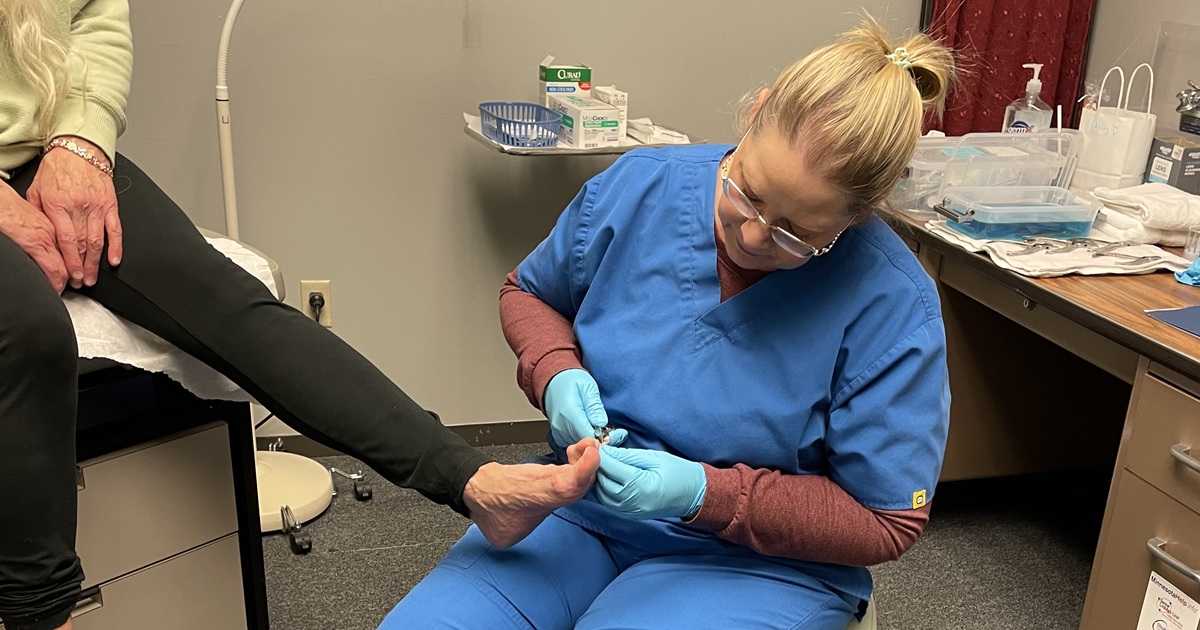
Nelson started the remarkably popular podiatry program at Project Care in Virginia. She and Dr. Sheckler clip toenails and provide other podiatry services, the demand for which results in lines snaking out the door. Dr. Seeber called it the “most important thing” we offer.
“I think Dr. Sheckler and Kelly are doing the work of angels,” Dr. Seeber says. “What a gift to the community. We’re so lucky to have them.”
Beyond the weekly volunteering, Essentia bolsters Project Care by providing lab and X-ray services at no cost to the Virginia clinic or its patients. Managing common conditions like hypertension and diabetes requires lab monitoring to ensure medications are properly dosed — something many patients simply couldn’t afford otherwise. Without it, some would land in the hospital with bills they could never pay.
Access to labs and X-rays allows the clinicians to provide the “same standard of care at Project Care that we do here in the clinic,” Dr. Seeber says.
“That’s a huge part of what helps us keep our patients healthy,” says Tiffany Schleppegrell, executive director of Project Care. “We’re so grateful for their support.”
Offering help — and hope
Project Care sees about 800 patient visits annually. Schleppegrell says many just need short-term help — a sports physical, preventive screening or medication adjustment. Other cases are more complex.
Skalko recalls one man who had lived in the woods for 15 years. With support from the clinic and community resources, he found housing and a job.
“We gave him help. We gave him hope,” says Skalko, who served as a licensed practical nurse for 31 years at the former Virginia Regional Medical Center. She says she’s flunked retirement three times.
Project Care operates on an annual budget of about $250,000, comprised mainly of grants and private donations. It couldn’t exist without volunteer clinicians.
“We wouldn’t be able to do it without those doctors,” Schleppegrell says.
And they have the capacity to treat even more patients. In a proud region like the Iron Range, the executive director knows part of the challenge is simply getting folks in the door. Project Care isn’t a handout; it’s an opportunity for people to get back on their feet.
If you’re avoiding the doctor because of finances, Schleppegrell says, “this is the place for you.”
“When you know people who have put off care for so long, and they have a serious diagnosis, it just breaks my heart knowing we’ve been here the whole time,” she adds.
For Essentia’s volunteers, the reward is time — time to sit with patients, to treat the whole person, to forge meaningful relationships and to help people improve their health and well-being. For the community, it’s something even greater — care without judgment, and the reminder that they are not alone.
Source link ← Back to News