Most of the world’s reef-building coral species are now considered endangered and 44% of corals globally are at risk of extinction, spelling trouble for nearly a quarter of the marine life that depends on corals, according to the IUCN.
Now Connecticut will have a hand in helping shape the future of coral conservation.
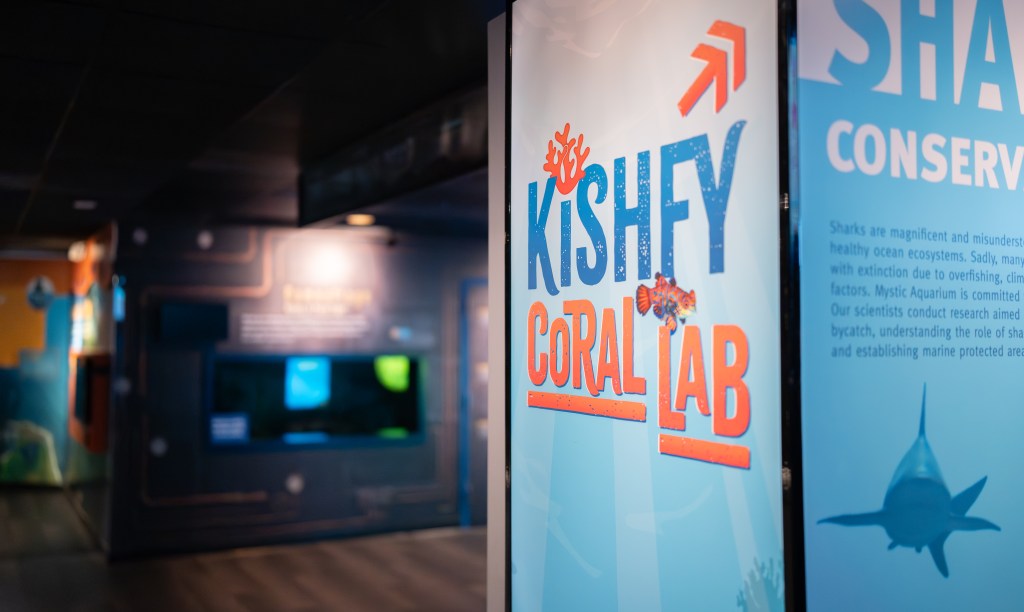
Mystic Aquarium recently opened the Kishfy Coral Lab, a new exhibit which combines education and science to highlight the aquarium’s conservation efforts, specifically those strengthening coral reef species across the world.
“Many reefs around the world are at high risk of full collapse in our lifetime,” said David Cochran, senior director of fish and invertebrates at Mystic Aquarium. “Corals and coral reefs occupy a very small percentage of the world’s footprint, but they are home to 25% of all marine life. They are sometimes called the rainforest of the ocean. They are vital to healthy marine ecosystems.”
Corals are not plants or rocks but invertebrates or living marine animals related to jellyfish and sea anemones, Cochran said. They consist of tiny, sac-like creatures called polyps that live in large, genetically identical colonies connected to one another. They cannot move or swim and are fully dependent on ideal ocean temperatures, acidity and sunlight, making them vulnerable to even the slightest changes.
“The warming of our oceans, pollution, overfishing, acidification and poaching has all contributed to a decline in our coral population,” Cochran said. “What’s challenging is that corals are not as resilient as other marine animals. Number one, they can’t move. They don’t migrate or move up and down the water column to get different temperatures or light variations. They really exist in a goldilocks zone since they are hyper specific on water temperatures, sunlight and acidity. The slightest disruption of their very narrow parameters can have some far reaching consequences.”

The new lab is entirely funded through private donations, including a large gift from Nick and Kate Kishfy, for whom the lab is now named. The Kishfy Coral Lab will serve a duel purpose of conservation and education, according to Cochran. The lab will allow visitors of all ages to explore up close, live corals in the lab through an interactive camera and a see-through glass wall into the lab, where marine scientists will conduct research.
“We love both corals and Mystic Aquarium. The corals got me in as a hobbyist, and what pulled us toward the aquarium was the work David and his team are doing. We wanted to back those conservation efforts by making a contribution that would help build and sustain a research-based approach to global coral conservation,” Nick Kishfy said.
The Kishfy family’s contribution supported the design and construction of the new space and provided critical resources to expand Mystic Aquarium’s work with coral spawning, growth and restoration, according to Mystic Aquarium. Additional donor support helped enhance the visitor experience and strengthen the conservation infrastructure behind the exhibit.
Cochran said the new lab space will help increase capacity for coral species at Mystic Aquarium and provide space for collaborations with other organizations. The space features a hybrid design with a traditional exhibit and a clear-glass view into the coral lab, allowing visitors to observe scientists at work on coral spawning and fragmentation through an installed camera.
The hope is that through research conducted in the lab, those same techniques can be replicated to conserve coral in the wild, he said. Mystic Aquarium researchers are partnered with a conservation group called Remote Ecologists. The group is currently conducting work on coral restoration and reef monitoring off the coast of Colombia in the Southern Caribbean.
“We will be using the lab to propagate corals and refine husbandry techniques that we can utilize in our conservation field efforts,” Cochran said. “Also, we can look at what areas of resiliency we can look at with these species to see if there are animals appropriate to certain conditions. We also want to see how we can inform the application of the science into conservation work.”
Cochran said the lab is interactive and allows visitors to get a really close “face-to-face” view of the corals using a close-up camera, to show the complexity of the marine creatures, and allow for greater public understanding.
“In addition to being an engaging and educational exhibit, the Kishfy Coral Lab allows us to expand our efforts to conserve coral species across the world,” said Dr. Allison Tuttle, chief zoological officer for Mystic Aquarium. “The work being done here at Mystic Aquarium in this new lab space will help visitors understand the vital role these fragile ecosystems play in our daily lives. We hope people leave curious, inspired and with a stronger sense of what they can do to help protect and preserve our oceans.”
Stephen Underwood can be reached at sunderwood@courant.com.